PRESS RELEASE
Lithium-Ion Battery Pack Prices Fall to $108 Per Kilowatt-Hour, Despite Rising Metal Prices: BloombergNEF
New York, December 9, 2025 – lithium-ion battery pack prices have dropped 8% since 2024 to a record low of $108 per kilowatt-hour, according to latest analysis by research provider BloombergNEF (BNEF). Continued cell manufacturing overcapacity, intense competition and the ongoing shift to lower-cost lithium iron phosphate (LFP) batteries helped drive down pack prices despite an increase in battery metal costs according to BNEF’s 2025 Lithium-Ion Battery Price Survey.
Battery metal prices increased in 2025, in part due to supply risks at certain Chinese lithium assets and new cobalt export quotas in the Democratic Republic of Congo. However, metal price increases did not translate to higher annual prices for cells or packs. The industry ultimately absorbed these shocks through greater LFP adoption, long-term contracts, and broader hedging strategies.
China has consistently produced more cells than are needed for domestic electric vehicle and stationary storage demand, creating intense competition among manufacturers. The effect has been most pronounced in the stationary storage sector, where many suppliers can serve the same projects. China’s dominance in LFP production has allowed its producers to meet nearly all global demand.
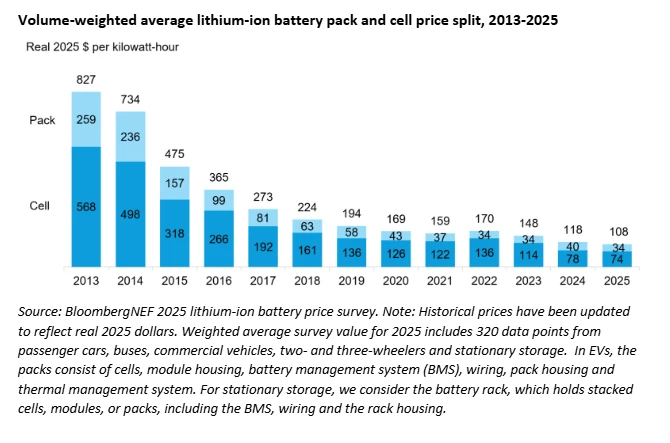
BNEF’s industry-leading battery price survey covers multiple battery end-uses, including different types of electric vehicles and stationary storage projects. Each sector typically requires different cells and packs to meet distinct performance metrics, leading to varied pricing dynamics across these use cases. Battery pack prices for stationary storage dropped to $70/kWh in 2025, 45% lower than in 2024. This is the sharpest drop across all segments, making stationary storage the lowest-priced segment for the first time. Battery electric vehicles (BEVs) packs were the cheapest in the transport segment at $99/kWh – the second year that they were below the $100/kWh threshold.
Average LFP battery pack prices across all segments came in at $81/kWh while nickel manganese cobalt (NMC) packs were at $128/kWh. BNEF clients can find the full breakdown by chemistry, application and country here.
Evelina Stoikou, the head of BNEF’s battery technology team and lead author of the report, said: “Cut-throat competition is making batteries cheaper every year. This is an important moment for the industry, as record-low battery prices create an opportunity to lower EV costs and accelerate the deployment of grid-scale storage to support renewables integration around the world. ”
The report also covers regional differences in pricing. Average battery pack prices were lowest in China, at $84/kWh. Pack prices in the North America and Europe were 44% and 56% higher, reflecting higher local production costs and greater dependence on imported batteries, which typically have a premium compared to prices in China. The largest drop in pack prices was in China, down 13% in real terms from 2024, while North America and Europe saw declines of 4% and 8%, respectively. The drop in prices was higher in Europe than in North America due to the changing policy and tariff environment in the US. Many Chinese companies redirected their exports to European markets, where they adopted more aggressive pricing strategies to maintain global sales volumes and meet annual targets. This shift intensified price competition in Europe.
BNEF expects pack prices to decrease again in 2026, based on its near-term outlook, as raw material prices face upward pressure but adoption of low-cost LFP continues to spread. Over the longer term, ongoing investment in R&D, manufacturing efficiency and supply chain expansion is expected to support further technology improvements and cost reductions. Emerging technologies, including silicon and lithium metal anodes, solid-state electrolytes, new cathode materials and new cell manufacturing processes, are also set to play a key role in driving the next wave of price declines.
The full report provides insights on:
- Battery prices across chemistries, regions and segments
- Raw material and battery component price dynamics
- BNEF’s view of global prices in 2026 and beyond
- Key drivers behind price trends this decade
- Public statements and roadmaps from leading industry players
- Impact of tariffs and transport costs on battery prices
BloombergNEF clients can access the full report here.
Media Contact(s)
For further information, please contact our media team.
Oktavia Catsaros
BloombergNEF
ocatsaros@bloomberg.net
About Bloomberg
Bloomberg is a global leader in business and financial information, delivering trusted data, news, and insights that bring transparency, efficiency, and fairness to markets. The company helps connect influential communities across the global financial ecosystem via reliable technology solutions that enable our customers to make more informed decisions and foster better collaboration. For more information, visit Bloomberg.com/company or request a demo.
About BloombergNEF
BloombergNEF (BNEF) is a strategic research provider covering global commodity markets and the disruptive technologies driving the transition to a low-carbon economy. Our expert coverage assesses pathways for the power, transport, industry, buildings and agriculture sectors to adapt to the energy transition. We help commodity trading, corporate strategy, finance and policy professionals navigate change and generate opportunities.
Related Content