REPORT
AI Data Center Build Advances at Full Speed: Five Things to Know
By Lloyd Arnold, Technology and Innovation Analyst, BloombergNEF
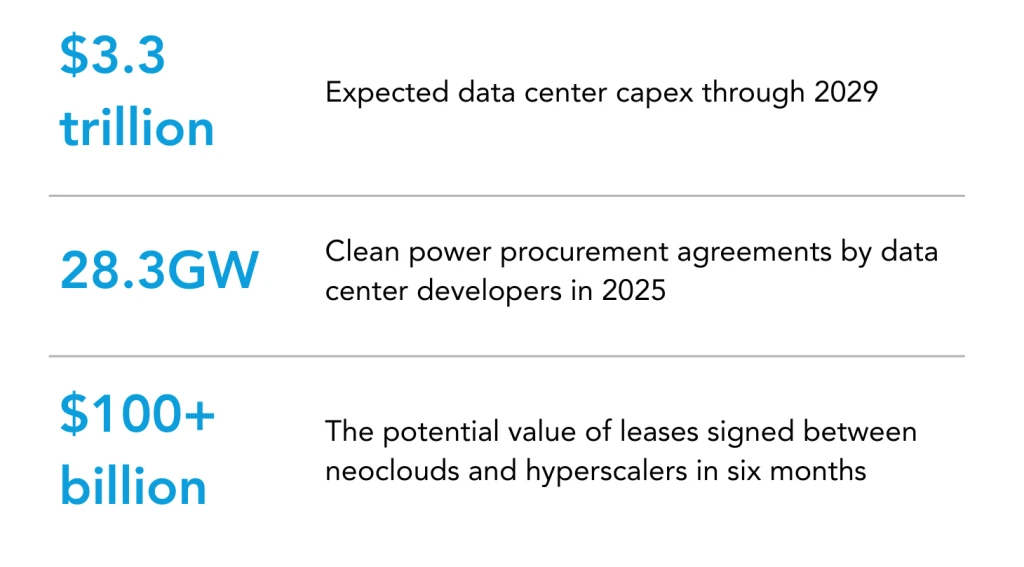
- Capex of largest data center firms nears $750 billion in 2026.
- Data center IT capacity under construction tops 23 gigawatts.
The digital infrastructure boom is continuing apace despite jitters in equity markets and fears of a “bubble”. The capital expenditure of the 14 largest publicly owned data center operators globally is seen close to $750 billion this year against a little less than $450 billion last year. They are procuring more energy than ever while private investors are pouring money into AI companies. Over 23 gigawatts (GW) of data center capacity was under construction globally at the end of September 2025, with about three quarters of it coming up in the US, as per the latest estimates from BloombergNEF.
By the numbers
1. Construction at 831 sites
Over 3.8GW of new data center IT capacity entered its construction phase in the third quarter of last year, which is up 58% on the quarterly average so far this decade. However, it is a 16% drop compared to the previous quarter. This could potentially indicate a slowdown in activity but BNEF believes it is likely due to a delay in reporting of new starts. There has been no indication of a slowdown based on conversations BNEF has had with industry stakeholders. Any revisions to this figure will, however, be a key indicator to watch.
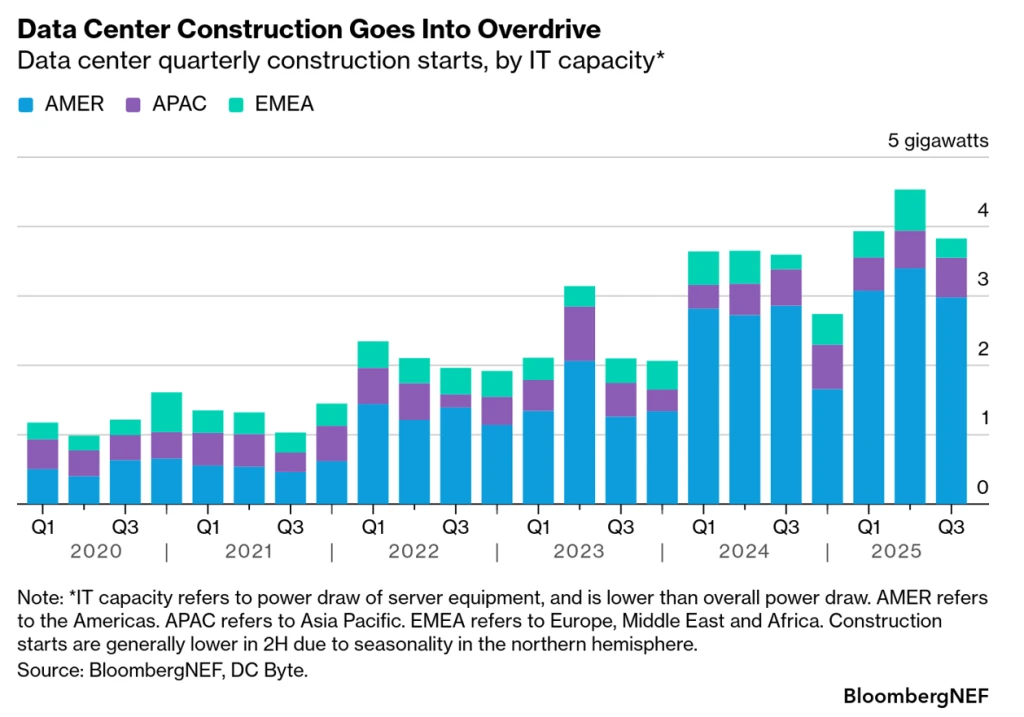
As much as 23.1GW of capacity is under construction globally, split across 831 sites. The Americas region hosts 17GW of this capacity, across 311 locations. Europe, Middle East and Africa or EMEA as well as the Asia Pacific (APAC) region trail significantly. APAC has marginally more ongoing construction, with 3.2GW across 283 sites versus EMEA’s 2.9GW across 258. The US alone hosts 15.9GW of ongoing construction.
2. US data center developers are big green power buyers
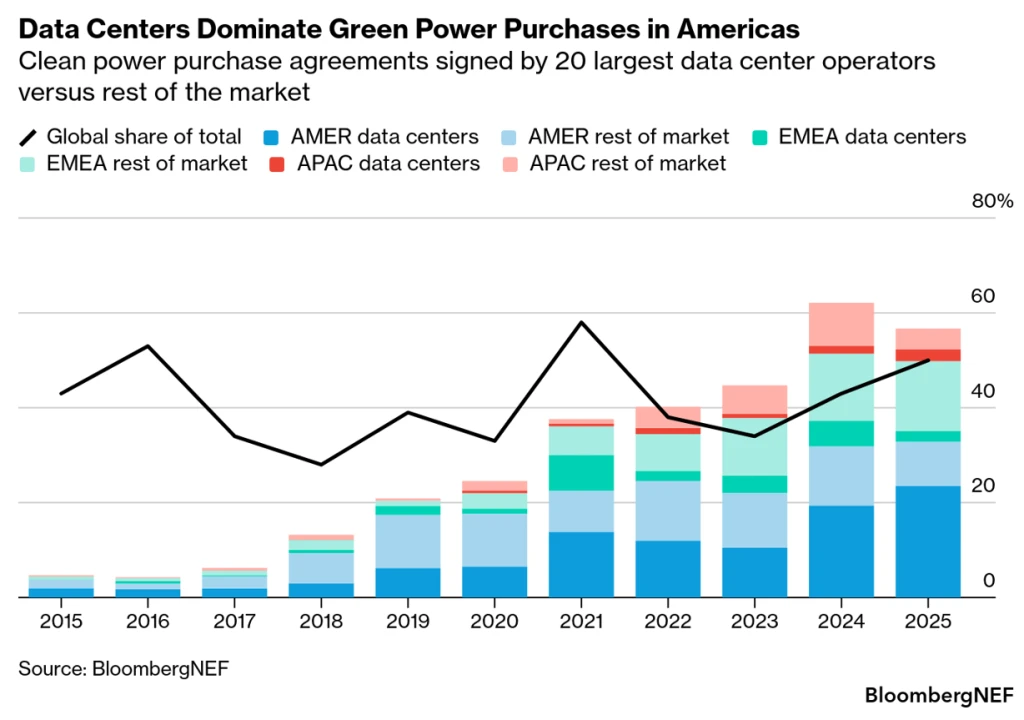
Large data center developers accounted for 72% of clean power procurement by corporations in the Americas region via power purchase agreements in 2025. They are less significant in Asia Pacific, where data centers account for about a third of PPA capacity, and in EMEA, where they represent just over an eighth.
PPAs signed by the world’s largest data center operators accounted for about half of all corporate clean PPAs in 2025, which was the second highest share of any year since the market exceeded 5GW in annual purchases. The only year to exceed 2025 was 2021, when Microsoft and Amazon ramped up procurement to reach over 18GW in a single year.
3. Capital allocations continue to climb
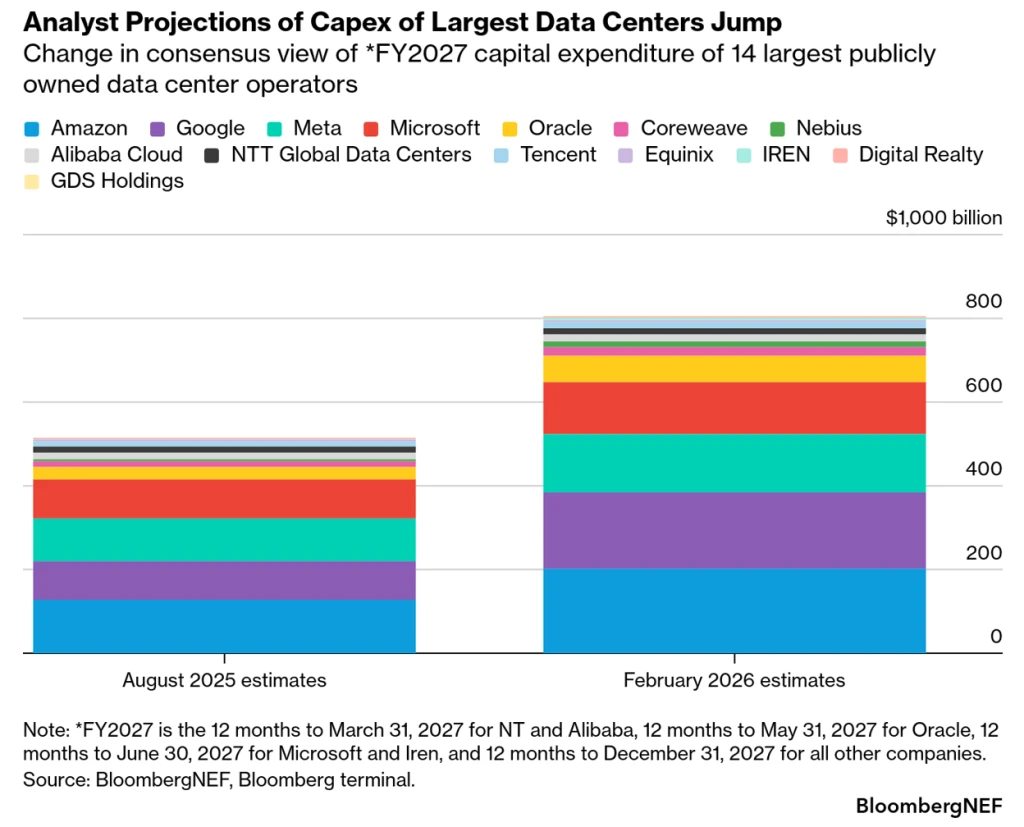
The already high capital expenditure estimates of data center developers have been revised upward significantly. Between August 2025 and February 2026, analyst expectations for spending by the 14 largest public data center developers in FY2027 climbed by 56%. This builds on already significant growth – capex tracked by BNEF jumped two thirds from FY2024 to FY2025, and is expected to climb by the same margin into FY2026. All of this highlights rising confidence in long term demand from the sector. Investors are less sure – three of the four hyperscalers lost market value following the most recent earnings calls, with concerns over high capital commitments weighing heavily.
4. Leasing drives confidence in neoclouds
The health of neocloud companies – notable for their GPU-as-a-service (GPUaaS) business model, and high optimization for AI workloads – continues to be an important indicator of broader market sentiment toward demand for AI compute. Over the six months up to March 2026, BNEF tracked leases signed by hyperscalers for compute capacity provided by the neoclouds that could together be worth in excess of $100 billion. The majority of the contracts are on five-year terms, with capacity being delivered from 2026.
For neoclouds, hyperscaler offtake has been critical to securing project financing and scaling buildouts, although these contracts are for much shorter periods than total asset life, which exposes the neoclouds to risk if long-term demand for AI compute is lower than expected.
5. AI and profitability
There is still uncertainty around the margins of providing AI services. AI inference is quite energy intensive, and requires more expensive hardware, than traditional software products. However, adjusted gross margins at the largest AI labs – Anthropic and OpenAI – are reportedly in the 30-40% region. Whilst lower than the gross margins posted by many existing software companies, they are a positive indicator of the health of the market. Current offerings can be provided in a profitable way, which suggests that inference demand will exist in the long run.
Download full report
The report will be sent to your email after completing the form.
Related Content