By Andrew Logan, Editor, BloombergNEF
Saudi Arabia’s plan to bypass a multi-million-barrel bottleneck already looks vulnerable.
The Kingdom’s Red Sea port of Yanbu was the target of an Iranian attack on Thursday, briefly halting loadings of crude after a rapid ramp up in export capacity earlier this month.
The strikes cast a cloud over an ambitious effort to divert millions more barrels per day from the besieged Persian Gulf to the Red Sea.
Broadening conflict, however, is not the Saudi plan’s only risk. Even as shipments resume, it’s not clear that the technical capacity actually exists for the Kingdom to fully sustain its export plan — nor if sailors will bear the threat of further strikes.
A Red Sea reset?
Following the closure of Hormuz, Saudi Arabia reduced output by around 2 million barrels per day, as Saudi Aramco CEO Amin Nasser raised the alarm over ‘the biggest crisis the region’s oil and gas industry has faced.’
The Kingdom promptly sought to redirect its remaining output to its Red Sea port, Yanbu, via a pipeline with a theoretical capacity of up to seven million barrels per day. As early as last week, supertankers were lining up to receive this redirected crude. By March 18, shipments from the port were averaging roughly 4.2 million barrels per day.
That effort now looks threatened as a drone fell on the port’s Samref refinery and a ballistic missile was intercepted. The strikes were in response to the bombardment of Iran’s South Pars gas field earlier this week.
Yet another route at risk
Saudi Arabia’s reroute is a vital escape valve for Gulf oil. But the strikes are a reminder that it also faces critical snags.
The most obvious is, of course, even more conflict. Strikes from the Houthis on Red Sea traffic may have ended following last year’s Israel-Hamas ceasefire, but the Iranian proxy could still prove highly disruptive once again — adding to the disruption.
Last week, Iran’s new Supreme Leader Mojtaba Khamenei warned of opening new fronts in the war, a promise he has executed on by targeting Yanbu. Though the Houthis have not yet entered the fray, the group’s leader Abdul-Malik al-Houthi has publicly signaled readiness to join hostilities even with munitions low.
The other risk is purely logistical: to what degree can crude be shipped from Yanbu?
Currently, Saudi Arabia has permitted customers to take April allocations via the port. However, those allocations are not in full, and remain constrained by pipeline capacity. The type of oil delivered is also limited, with refiners only offered Arab Light grade.
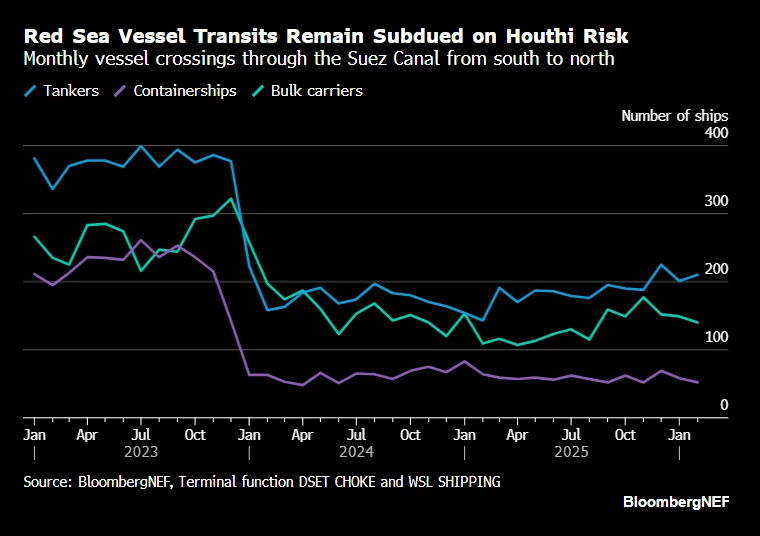
Though nearly 30 tankers had already stationed near the port as of March 16, the traffic via the Suez route remains well below its peak. Now, with strikes expanding to the Red Sea, it’s an open question if sustained tanker traffic would materialize to capture diverted crude from Yanbu.
What’s the worst that can happen?
Even under the best possible scenario — in which Iranian strikes cease and capacity ramps up — the Red Sea diversion would hardly patch the Hormuz-driven deficit.
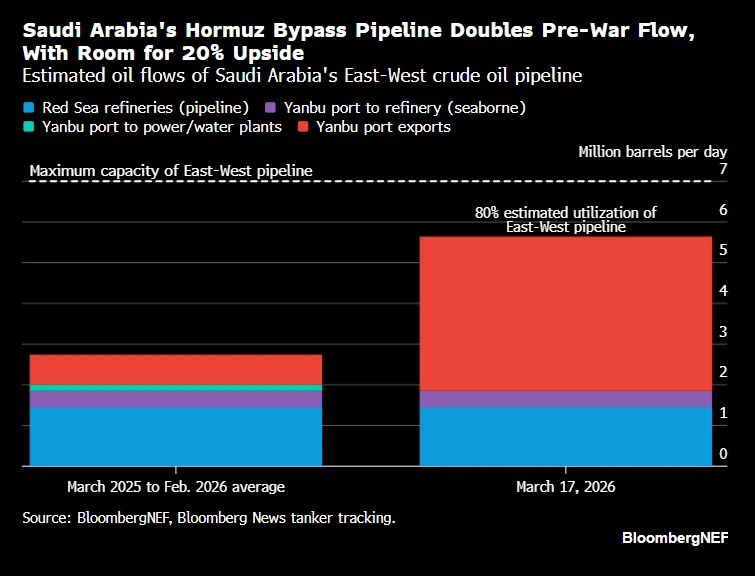
As it stands, the global oil supply is set to dive by 8 million barrels per day in March, according to the International Energy Agency. In the best case – if pipeline, port and shipping capacities operate at their peak – the Saudi Hormuz bypass strategy could divert around 4.3 million barrels per day of incremental pipeline flows. BNEF estimates that Saudi has already reached close to 3 million barrels per day of incremental flows, doubling the pre-war utilization of the East-West pipeline to 80% on March 17, 2026.
Such a boost is unlikely to fully materialize.
Prior to the war, the pipeline was delivering around 5 million barrels per day of oil. The objective now is a lofty 7 million barrels per day, according to Aramco’s Nasser. Moreover, shipments from Yanbu have more than tripled their typical levels between 1.2-1.4 million barrels per day seen in recent months. Whether the port can cope with full utilization of the projected 7 million barrels per day of pipeline flows has yet to be seen.
But what happens if further strikes materialize, whether by Iran or the Houthis, and any single element of the diversion collapses?
The pipeline, for instance, is highly vulnerable. In 2019, Houthi rebels struck Saudi Arabia’s Abqaiq plant, a key facility feeding the pipeline, suspending 5.7 million barrels per day of output.
Should the rebels ramp up activity again and choke off the Bab el-Mandeb Strait — the southern entrance to the Red Sea — another bottleneck would emerge. Vessels bound for Asia, one of the regions worst hit by the current supply deficit, would need to divert through the Suez Canal route. That could add weeks, if not months, to their journeys. And of course, should the further strikes shutter the port, all bets are off.
The Red Sea reroute is far from a Panacea, especially now as it’s become a target. Saudi Arabia will not only need to push its infrastructure to the limit, it must also ensure protection from strikes and convince sailors its port is safe. That’s more than a tall order.