By Vandana Gombar, Senior Policy Editor, BloombergNEF
The 400 million barrels of oil to be released by the International Energy Agency from emergency reserves amid turmoil unleashed by the Iran war is a record, but will only cover about four days of global demand.
Brent crude briefly jumped back above $100 a barrel on March 12 as the escalating conflict triggered more shipping upheaval in the Middle East while China tightened fuel export curbs to cope with the fallout from the war.
“It is a relief for the oil market, but apparently not enough to stem overall supply concerns,” said David Doherty, BloombergNEF’s head of Natural Resources Research, said of the IEA release, citing days of whipsawing oil prices. “We see structural oversupply re-anchoring prices if the supply shock is temporary.”
Here’s three things you should know about oil markets.
1. Oil balance
There was near consensus among key agencies on 2026 being a year of surplus oil production. The IEA, the US Energy Information Administration and BloombergNEF were all predicting oil demand in the region of 105 million barrels a day, with the Organization of the Petroleum Exporting Countries predicting as much as 107 mb/d.
With global supply estimated at around 108 mb/d this year, a surplus supply of about 3 million barrels per day was projected in BNEF’s most recent update, published two days before the war started. The IEA’s latest forecast, released earlier Thursday, sees the war slashing global oil supply by 8 million barrels a day.
2. Production cuts
Disruption of oil flows through the Strait of Hormuz has led Saudi Arabia to start reducing oil production, Bloomberg News reported. The kingdom produces about 10 million barrels a day of oil and exports about 7 million. Other leading producers like the UAE, Iraq and Kuwait are also scaling back production. The decision to ease some sanctions on Russian oil is partly an attempt to fill this gap.
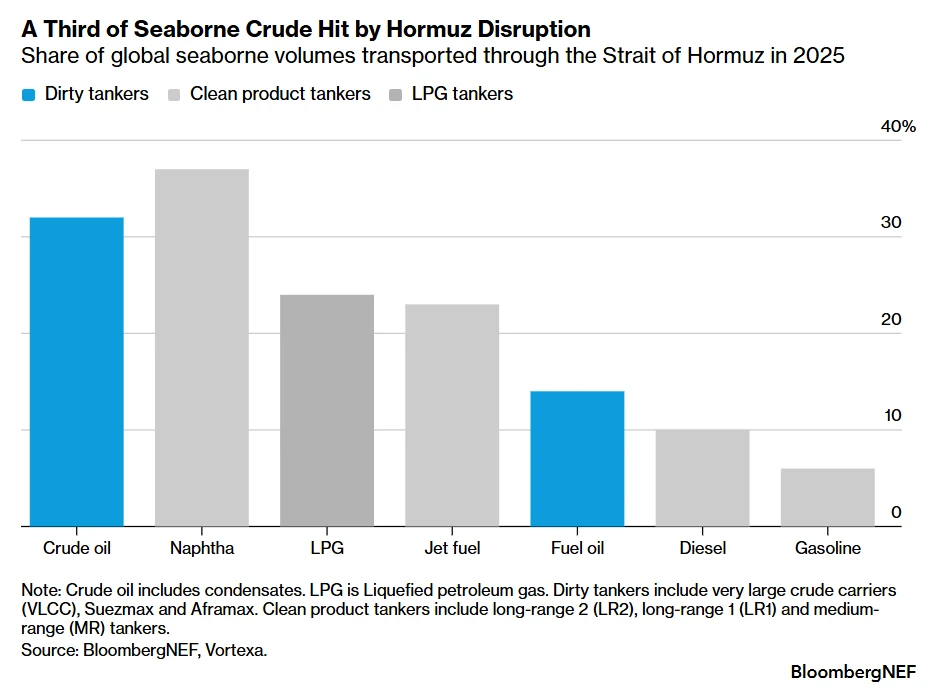
About 14 million barrels per day, or 32% of global seaborne crude oil, normally transit through the strait of Hormuz, trade which is all but stopped.
3. Supply support
The IEA’s decision to release 400 million barrels is more than double the 183 million barrels unlocked after Russia invaded Ukraine. Executive Director Fatih Birol cited the “unprecedented” challenges in the oil market for the “emergency collective action of unprecedented size” by IEA member countries.
The Trump administration will draw down 172 million barrels from its Strategic Petroleum Reserve as part of the coordinated effort to manage the supply shock. The reserve currently holds about 415 million barrels — little more than half its capacity — following drawdowns during Joe Biden’s presidency.
Related Content