By Mohith Velamala, Specialist, Downstream Oil and Chemicals, BloombergNEF
Escalating conflict in the Middle East poses a direct threat to around 14 million barrels per day, or 32% of global seaborne crude oil, that flows through the Strait of Hormuz. For oil products, any Strait of Hormuz disruption would impact 16% of the global products trade, with severe consequences for LPG (liquefied petroleum gas) and naphtha.
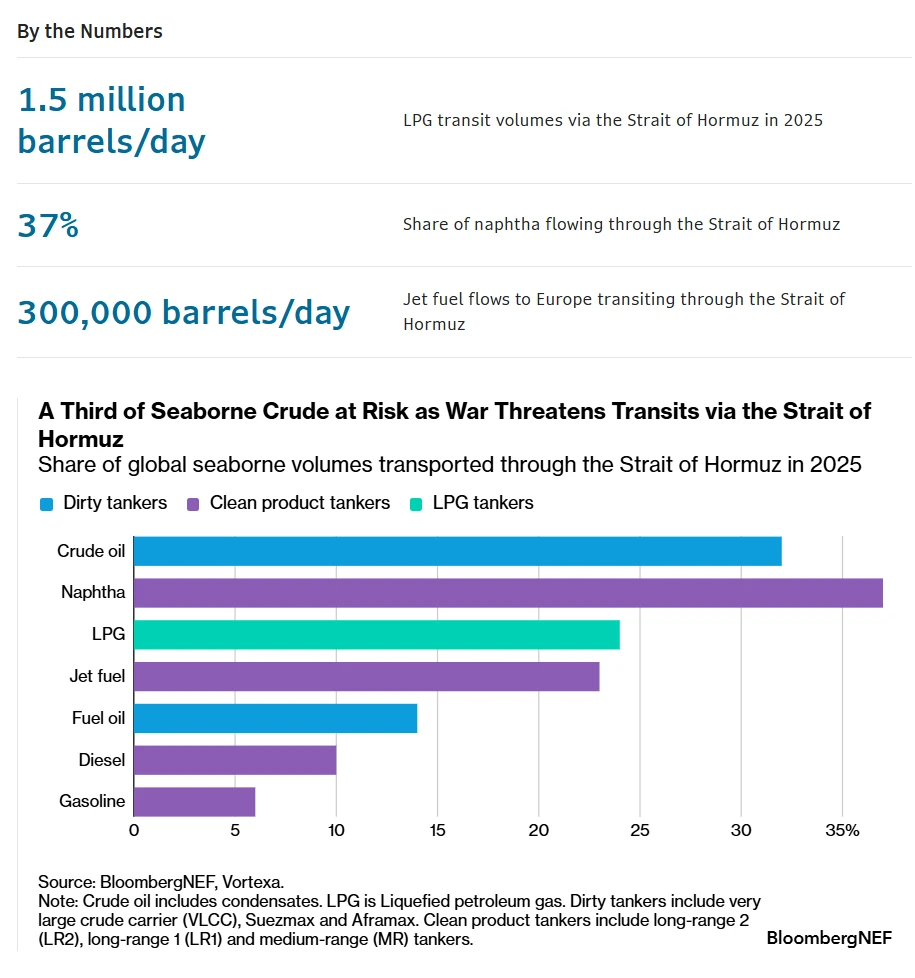
Any disruption to tanker transits through the strait would cripple the global trade of oil and oil products.
Strait of Hormuz transit volumes are about 1.5 million barrels per day (b/d) for LPG and 1.2 million b/d for naphtha. Naphtha flows to East Asian crackers are particularly exposed, with more than 37% of those global seaborne volumes transiting the strait.
LPG markets are already tight following last week’s outage at Saudi Aramco’s Juaymah facility. This poses a specific threat to India, which relies heavily on Middle Eastern LPG for residential use. Replacing these short-haul cargoes with longer voyages of LPG from the US would present a severe logistical challenge for countries in Asia.
For middle distillates, diesel flows through the strait are roughly double those of jet fuel. But jet is more vulnerable in terms of overall market share. European jet kerosene buyers are particularly sensitive, as more than half of the continent’s jet fuel imports sail through this strait. In the event of sustained disruption, Europe would need to pivot to alternative suppliers such as India, South Korea, the US, and even Nigeria’s new Dangote refinery.
A similar dynamic also applies to diesel due to Europe’s sanctions on oil products from Russia. As Europe pulls more non-Russian barrels of diesel from the global pool, African buyers may increasingly turn to Russian diesel to fill their gap. Russian refinery throughput fell to 5.15 million barrels per day (b/d) during the first 18 days of February 2026 due to continued Ukrainian drone attacks. Russian refined product exports declined by 270,000b/d over the same period, led by lower fuel oil and diesel exports.
BNEF clients can access the full report here.
Related Content