On Feb. 28, the US and Israel launched missile strikes on Iran. Within days, Iran responded militarily, then economically by dramatically clogging the flow of oil, gas and other goods through the Strait of Hormuz.
Given the interconnectedness of the global economy, the Iran war’s impacts have been felt in most corners of the world ever since. But the implications have varied widely.
With the conflict officially reaching the six-month mark, BNEF asked each of its regional experts a simple question: How has the conflict affected the energy transition in your part of the world?
India and Southeast Asia
Shantanu Jaiswal, New Delhi
The war’s impact on the energy transition in South and Southeast Asia has been heavily influenced by governments’ efforts to shield consumers from rising power and transport fuel prices.
India and Indonesia produce about two-thirds of their electricity from burning domestic coal and were therefore largely insulated on the power side. But the war exposed Vietnam and the Philippines’ heavy reliance on imported fuels. Both rolled out fuel subsidies and tax exemptions, along with power market interventions designed to protect consumers. In the Philippines and Malaysia, rooftop solar additions surged.
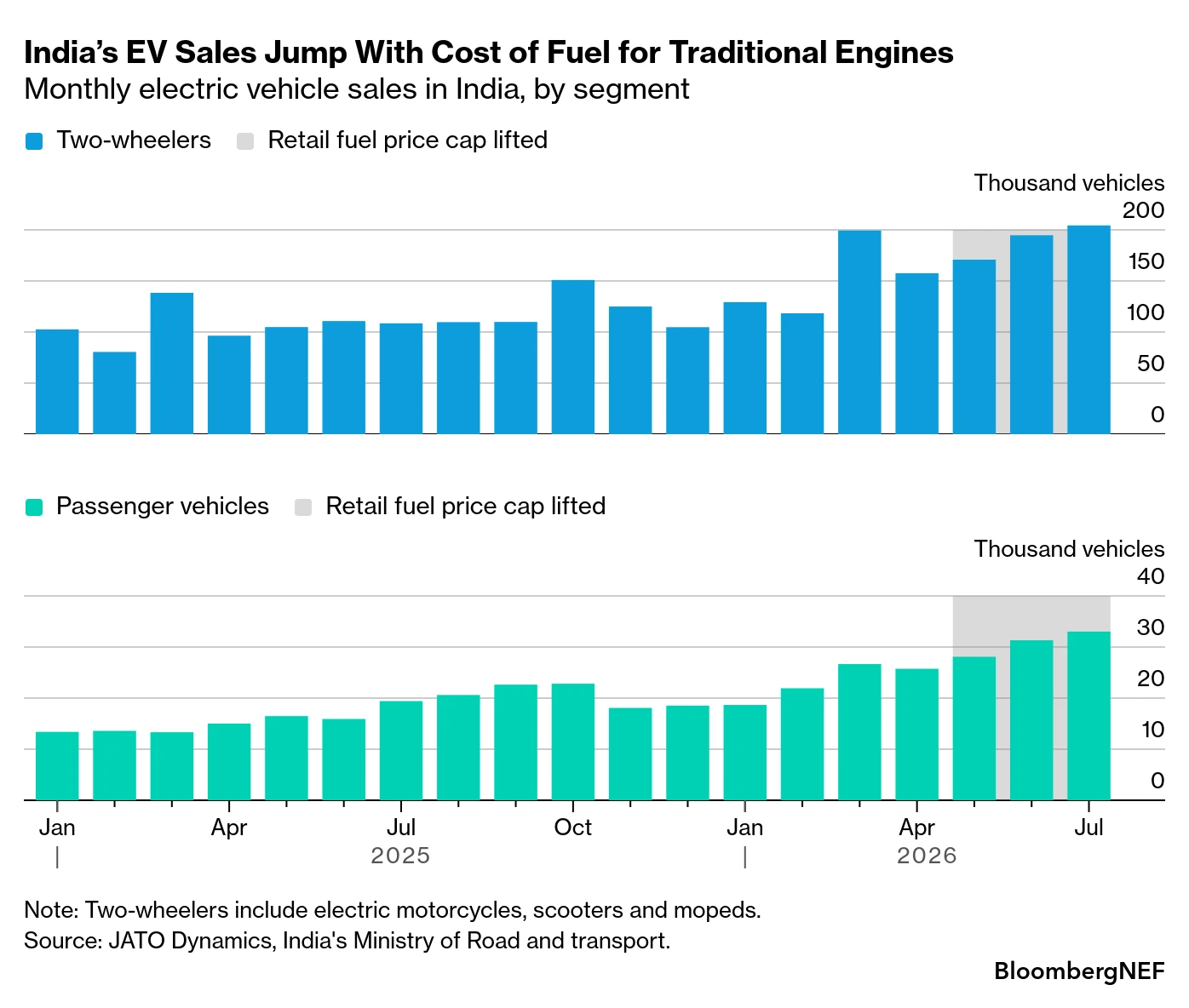
If the power sector was relatively insulated in some nations thanks to domestic resources, the transport sector was highly exposed virtually everywhere. Consumers are responding: monthly electric vehicle sales are about double what they were at this time last year in Indonesia and the Philippines, which along with Vietnam announced new policies to promote sales.
India’s sales of electric two-wheelers increased steadily after measures to keep gasoline prices down were lifted in May. After a period of steady growth, passenger EV sales in India have now passed 30,000 units in June and July, from less than 20,000 a month during the same period last year.
Related insights for BNEF clients:
China
Leo Wang, Shanghai
Sisi Tang, Beijing
China’s energy sector has held up well in recent months, despite its structural dependence on imported hydrocarbons.
By placing energy security at the heart of national policymaking well in advance of the war, the country steadily expanded domestic oil and gas supply and reserves. It now holds one of the world’s largest petroleum reserves and has pushed domestic gas production to record highs. This has cushioned the shock from the Gulf conflict and allowed China to act as a key balancing force in global markets by slashing imports.
Overall, the energy transition and energy security are proving to be mutually reinforcing rather than competing priorities in China. Rapidly scaling renewables are joining domestically fueled coal plants to make the country’s power generation more self-reliant.
Gasoline demand is sinking as more than half of new cars sold in China are now electric. Renewables deployment is beginning to plateau as key reforms take effect, but not before installed capacity had reached a very high level.
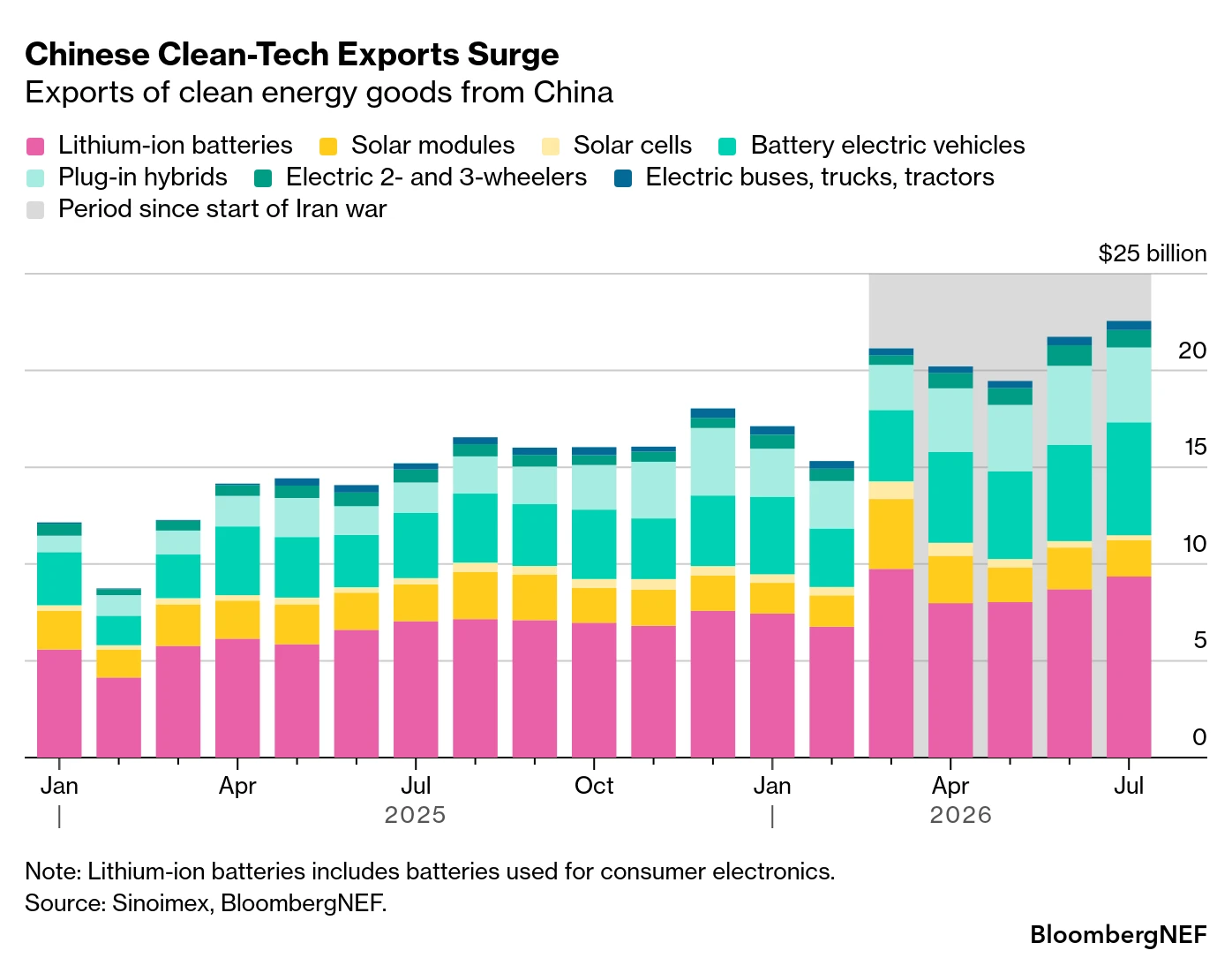
China is also by far the world’s largest producer of clean energy equipment such as solar modules, EVs and batteries. Exports of these products surged in the month immediately after the war began. At first, this reflected a change to a key domestic export subsidy, but the country has now logged five straight months of record exports, as measured in dollars.
Related insights for BNEF clients:
Africa
Nelson Nsitem, London
African nations have been hurt by their strong dependence on imported oil products. Before the conflict, major economies including Morocco, Egypt, Nigeria, Ghana and South Africa were all net importers of refined oil products. All have directly suffered from subsequent global fuel price shocks.
Effects are often felt acutely at the local level. Most African homes and businesses rely on petrol or diesel generators to live and work, since local grids are often unreliable. As the Iran war boosted global fuel prices, generator running costs rose, exacerbating unstable power supply situations in many countries.
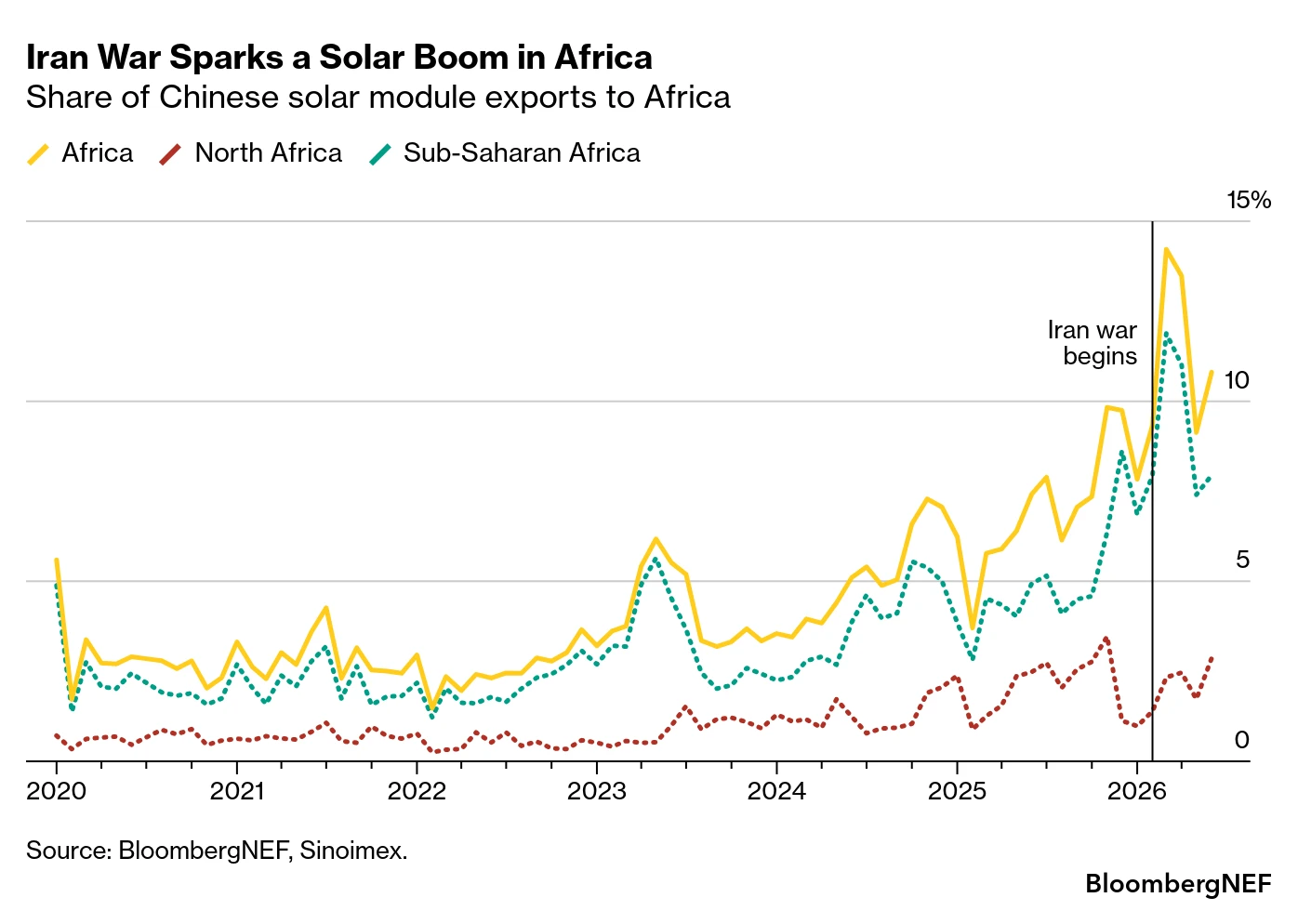
The silver lining has been the availability of inexpensive solar equipment, mainly from China. Like South Africa’s 2022 power crisis and Nigeria’s 2023 removal of subsidies, the Iran war has spurred solar demand. Africa’s imports of Chinese solar equipment grew 37% from 1H 2025 to 1H 2026, the highest rise in any region globally over that period.
Prior solar booms were concentrated in individual nations, but the current growth appears to span the continent, from South Africa to Nigeria, the Democratic Republic of Congo, Egypt and Morocco. Governments and citizens are looking to reduce their exposure to fuel price shocks, and are increasingly aware that solar is an economic option to do that.
Related insights for BNEF clients:
Europe
Adithya Bhashyam, London
Europe has been heavily exposed to the Iran war through its dependence on refined products from the Persian Gulf. Almost half of the European Union’s jet fuel imports and nearly a fifth of its diesel imports pass through the Strait. Even so, the impact on particularly vulnerable jet fuel supplies has been milder than expected, helped by relatively low demand, alternative imports and higher domestic refinery output.
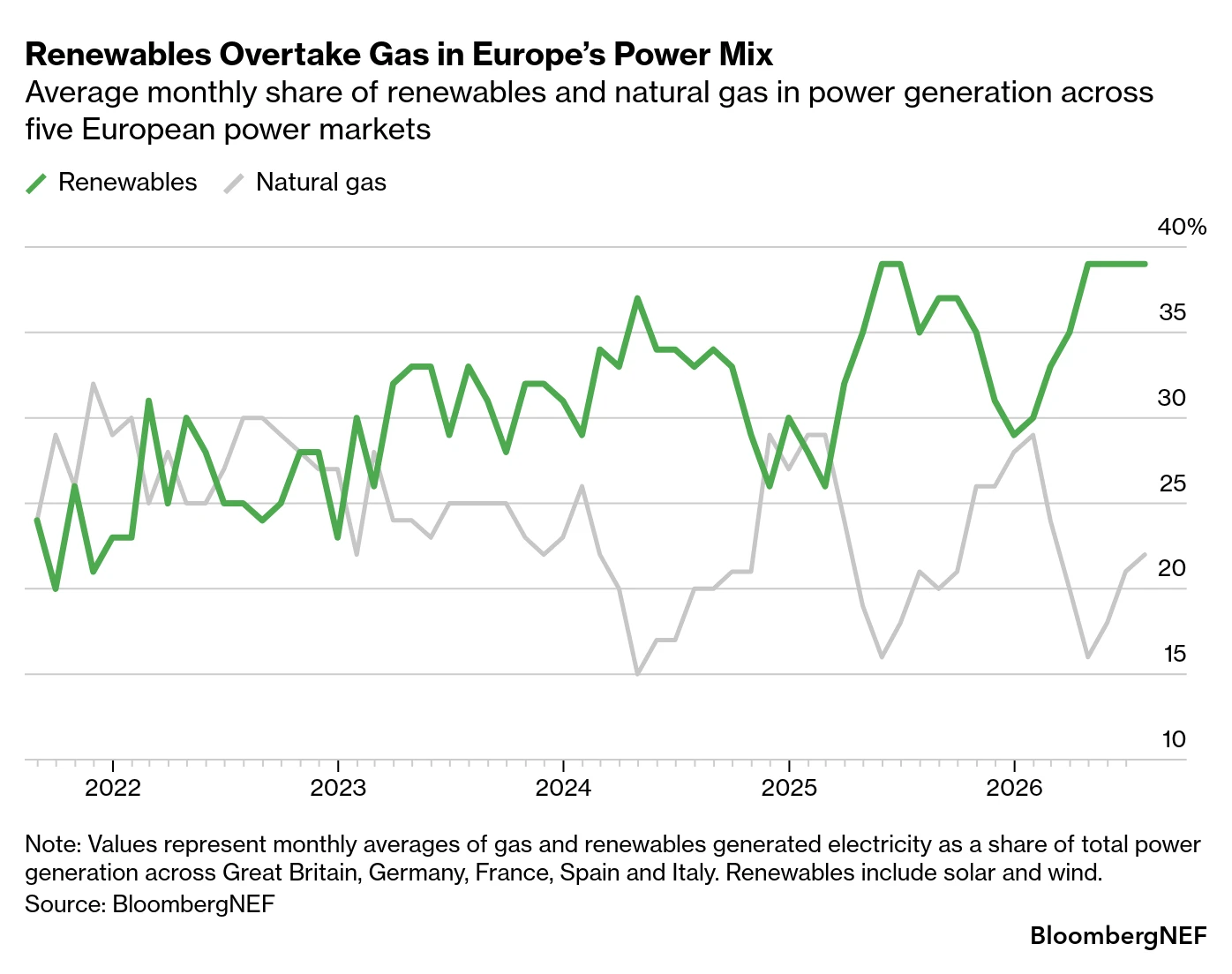
Europe’s electricity system is also better placed to weather gas price shocks than it was when Russia invaded Ukraine. Renewables now supply 35% of power across the five core European power markets, up from 24% in 2021. Together with lower demand, that has softened the power price shock.
Policy responses have so far focused on shielding consumers from higher costs than speeding the transition to different energy sources. That helps in the short term, but it weakens incentives to cut fossil fuel demand and puts more pressure on stretched public finances. Germany is one exception, increasing onshore wind auction volumes by 12 gigawatts in response to the war, and BNEF expects other markets to at least maintain, if not raise, their renewables ambition to promote resilience.
Faster electrification and tackling Europe’s high retail power prices are also moving up the bloc’s policy agenda, although funding to date has been limited. Europe may also take a lesson from China and build larger strategic fuel reserves to cushion future shocks, particularly as it heads into winter with gas storage at a decade low and a tight middle distillate market.
Related insights for BNEF clients:
Latin America
Rafael Rabioglio, Sao Paulo
Latin America’s relatively limited dependency on oil imports has shielded it from some of the first-order effects other regions have felt. Still, the war’s impact has been apparent.
On the oil side, markets that were already ramping up production (Brazil, Argentina and Guyana) posted record revenues as prices spiked and importers sought non-Gulf suppliers. Higher copper and lithium prices benefited the region’s largest exporters, including Chile and Peru. And rising oil prices globally pushed Brazil – already the world’s second-largest biofuel producer – to boost the mandated share of ethanol in gasoline blends.
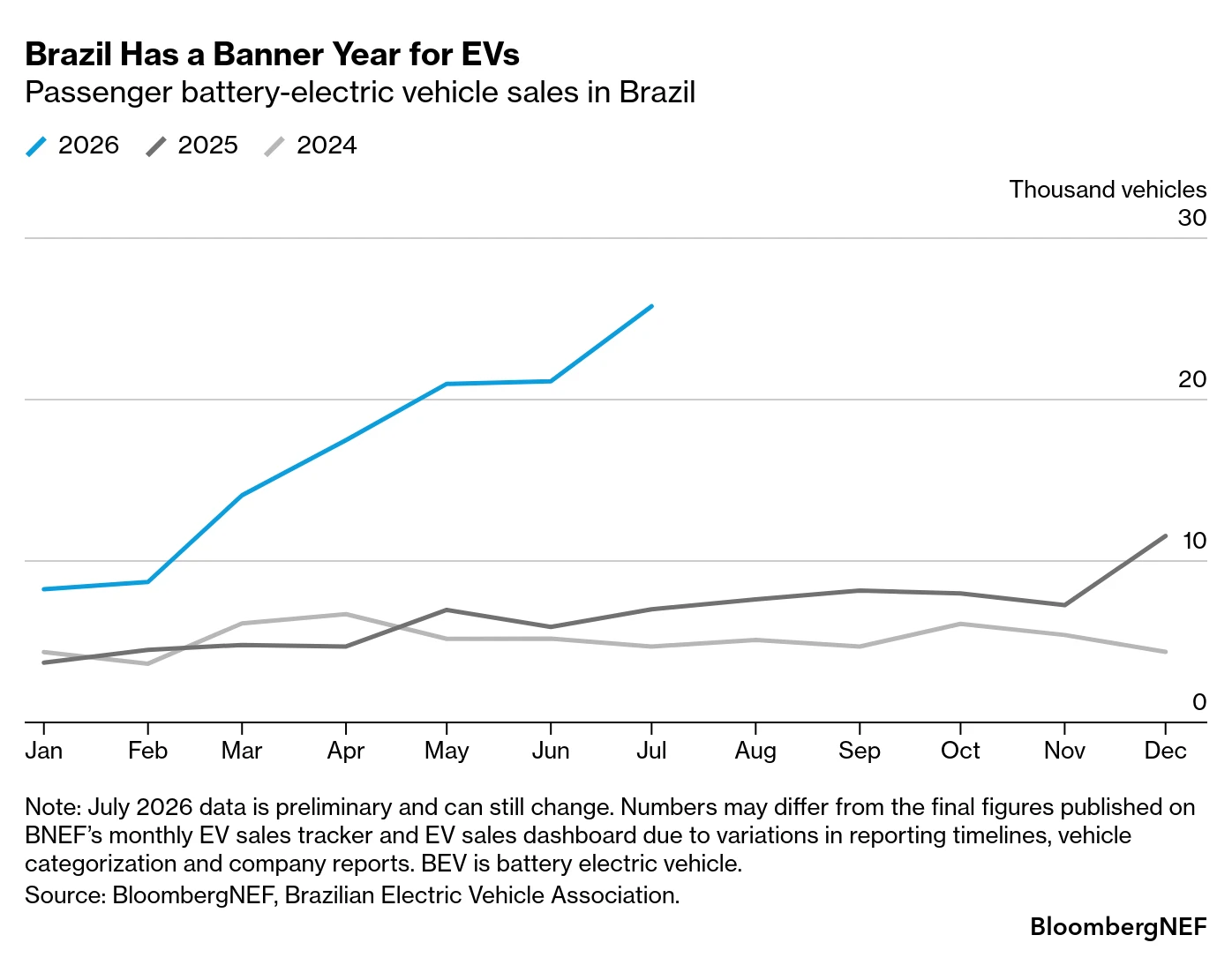
Battery electric vehicle sales were already rising in Latin America thanks to reduced import tariffs, tax incentives and falling battery prices. Yet sales figures in recent months have soared. Monthly sales of battery-electric vehicles in Brazil passed the 15,000-unit mark for the first time in April; by July, the figure had surpassed 25,000.
Moreover, since the war began, Brazilian imports of Chinese EVs have soared. Some 166,000 BEVs and plug-in hybrids were imported in April and May, making these the two biggest months for such imports on record. For scale, 401,000 vehicles (of any drivetrain) were sold in Brazil during that same period.
If oil prices moderate and ethanol supply increases, the temporary EV boost could decelerate. On the other hand, the boost to Latin America’s mining sector could remain. Electrification is increasing structural demand for key energy transition metals, and ongoing supply constraints that drive up global prices are likely to benefit resource-rich nations in Latin America.
Related insights for BNEF clients:
Middle East
Abdullah Alkattan, London
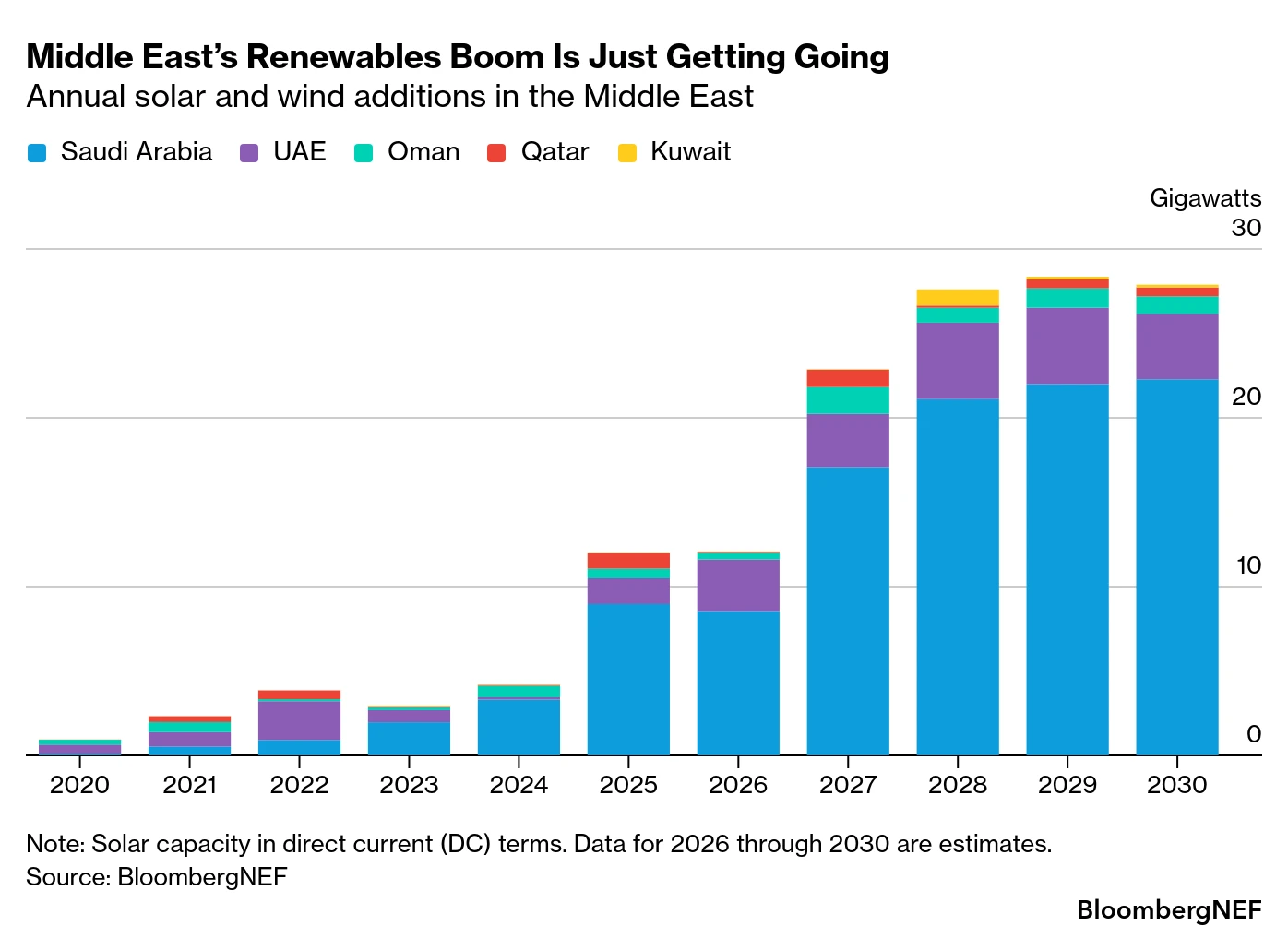
The war’s economic impact on Middle Eastern oil producers has been directly correlated with their capacity to bypass the Strait of Hormuz. Saudi Arabia and the UAE have leaned on existing bypass capacity to soften the economic blow, and will look to step up investment in infrastructure redundancy. Oman’s direct ocean access means it has emerged as a “winner.”
Yet the rest of the region has limited options. Long viewed as a reliable global energy supplier, the region’s priority will now be to increase resilience in the face of constrained fossil fuel exports and, where possible, decrease exposure to Hormuz.
Renewables can play a direct role in supporting these plans. Wind, solar and storage deployment helps nations cut domestic consumption of fossil fuels for power generation, making more available for export.
The war has driven up the cost of debt in the region, undermining clean power project economics in the near term. While this could lead to some delays, in the longer term, the war could mark start of a new phase of renewables growth in the Middle East.
Related insights for BNEF clients:
US and Canada
Derrick Flakoll, Washington
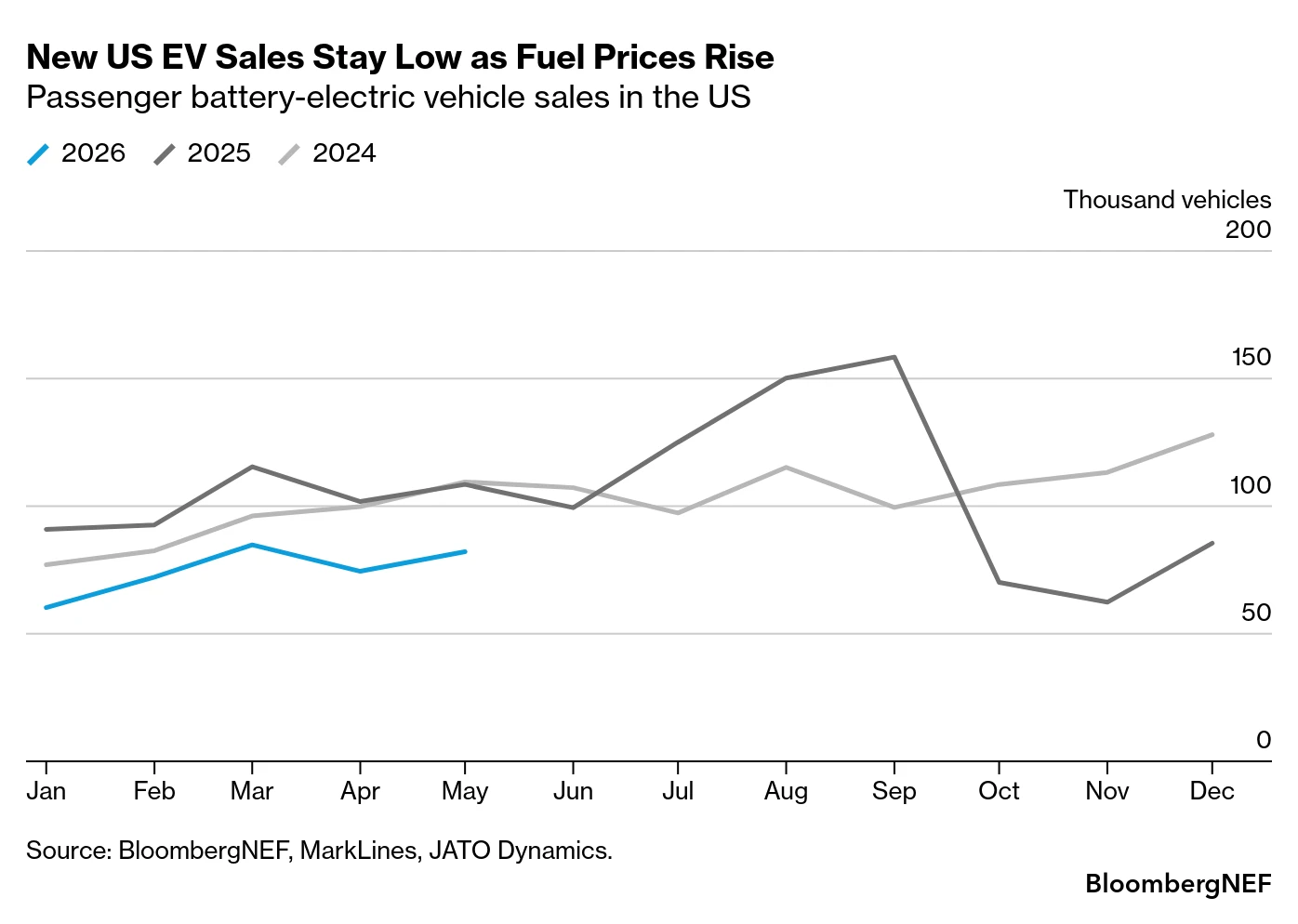
The US economy has proven largely resilient to the impacts of the war so far, mostly blunting any sense of urgency among consumers, businesses and most policymakers to transition away from fossil fuels.
Ample local natural gas production coupled with maxed-out liquefied natural gas (LNG) export terminals have kept natural gas and power largely prices in check. Rising liquid fuel prices have been a boon for US oil producers and refiners, but are also contributing to inflation and consumer frustration.
Higher gasoline (petrol) prices have boosted demand for conventional hybrids and used EVs, but with generous federal purchase subsidies now gone, US consumers haven’t flocked to new EVs. For their part, US automakers aren’t revisiting decisions made at the start of the Trump administration to re-emphasize large internal-combustion energy (ICE) pickups while de-emphasizing EVs.
Canada, meanwhile, has advanced its energy transition domestically as EV sales and clean electrification accelerate. However, the country’s simultaneous attempts to exploit rising global demand for non-Mideast oil and gas complicate the story.
Since the war began, Germany and South Korea have committed to buy more Canadian fuel and invest in the country’s fuel-production infrastructure. For his part, Prime Minister Mark Carney has sought to further Canada’s “energy superpower” status with oil exports, trade deals, expanded clean power and EV production, more carbon capture projects and higher carbon prices in oil-producing Alberta. It’s a complex agenda that from a climate perspective can at times feel in conflict with itself, as Canada tries to put energy security and its economy first while continuing to decarbonize when it feels it can afford to.
Related insights for BNEF clients:
Japan and South Korea
David Kang, Seoul
As highly import-dependent energy economies, Japan and South Korea felt the disruption immediately.
Pre-war, 70% of Korea’s and 90% of Japan’s crude oil supplies passed through the Strait of Hormuz. After the conflict began, regional LNG spot prices soared, forcing both nations to tap strategic petroleum reserves while absorbing painful surges in wholesale power costs. To maintain reliable power, utilities increased coal-fired power generation and purchased expensive spot LNG cargoes. Those measures bought time, but they also exposed how expensive it is to defend economies built on imported molecules.
The war has now reframed the case for the energy transition in Japan and South Korea. Korea made that link explicit in April, citing the conflict in a plan to reach 100GW of renewables and more than 20% renewable generation by 2030, alongside investment in grids, storage and electrification. It has also sought to speed EV adoption in the name of energy security.
Japan has offered less of a policy pivot, but the crisis has reinforced the energy-security logic behind nuclear restarts and domestic renewables already embedded in its 2040 strategy. Tokyo remains wary about exchanging over-reliance on Gulf oil and gas for over-reliance on Chinese-made clean energy goods, however.
The contradiction is that both governments are cushioning fossil-fuel prices today while arguing that locally produced electricity is the route of tomorrow. Six months in, the war has not visibly transformed project pipelines, but it has made energy security a stronger case for decarbonization in Japan and Korea than climate policy alone.
Related insights for BNEF clients:
Australia
Leonard Quong, Sydney
Australia has so far avoided the most catastrophic outcomes stemming from the Iran war, but it hasn’t remained unscathed.
A combination of abundant natural gas production, and LNG exporters willing to forgo gouging for lucrative export opportunities, kept domestic gas prices low for consumers. As a direct consequence, power prices across the country have remained at, or even below, pre-war levels.
The greatest impacts have been felt at the bowser. Australia remains largely dependent on imports for refined oil. In the immediate aftermath of the war, high international spot prices and panic buying (particularly for diesel in rural areas) resulted in soaring prices and even localized scarcity.
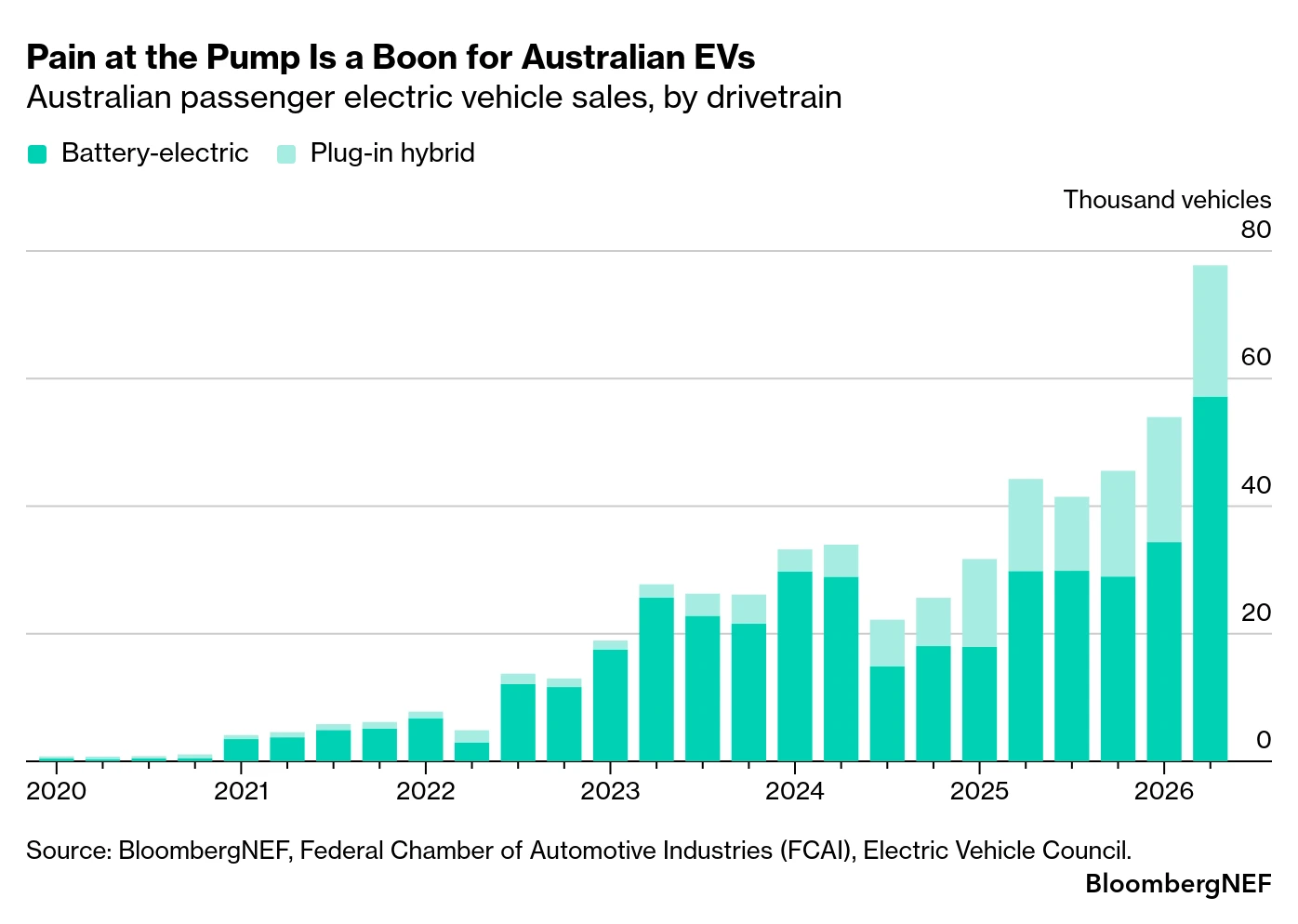
In a one-two punch, just as petrol and diesel prices soared, Australia’s first EV policy was beginning to bite. Nearly as many EVs were sold in the first half of 2026 as across all of 2025.
Despite this, as initial policy support rolls off, and the conflict drags on, concerns linger about the nation’s ability to reliably source low-cost oil cargoes for its future needs. Australia could face a problem with sticky inflation, given how heavily exposed the country’s transport, agriculture and resource sectors remain to international oil prices.
Related insights for BNEF clients: