By Vandana Gombar, Senior Editor, BloombergNEF
How quickly can you get me power? That’s the key question Conor Andrus keeps hearing as his firm, Joule Capital Partners, builds data centers at a sprawling facility in the US state of Utah.
“Right now, it’s a very hotly contested race of who can get the most compute. The most compute is driven by the most amount of power,” Andrus, managing partner and head of capital markets, said in an interview.
“That bodes well for our project because we know when we can deliver the power and we can be really creative around the structures that are going to house the equipment,” he said.
Joule is building data centers across a 4,000-acre campus in Utah which will be fed by its own power plants tallying 1.5 gigawatts in the first phase. Securing a new power connection from the grid is a time-consuming process and there is a long queue for equipment to set up captive power plants. Joule has already secured kit it needs and will be ready to host clients later this year, according to Andrus.
Caterpillar’s natural gas engines for power generation will be delivered from next month, he said. Temporary structures to house compute power will be ready soon, while halls will start coming online by the end of next year. “Speed is the name of the game,” Andrus said.
The company secured $60 million in series B funding last month from Clear Lake Investments and Foulger Pratt. It expects to sign its first client soon. Whether that will be a large company – a hyperscaler – seeking a big footprint within the development or a clutch of smaller neoclouds remains to be seen. “We are talking to customers in both groups,” he said.
Utah was one of the first states to enable large power users like data centers to set up their own power plants. “The site was selected because of availability of power, water and fiber. Low latency fiber,” Andrus said, referring to networks with superfast data transmission.
Conor Andrus
Managing Partner, Joule Capital Partners
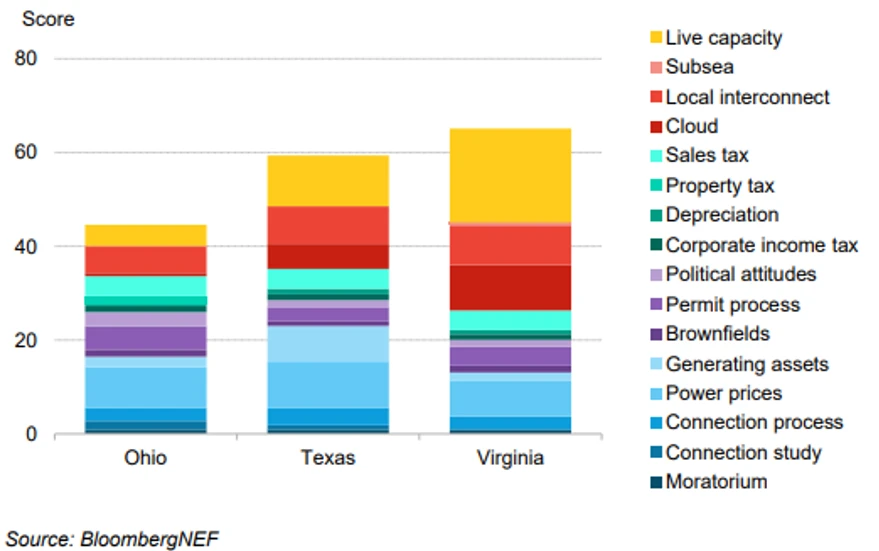
Land permitting, market size and taxes also play a role in deciding data center locations, with states such as Virginia and Texas scoring high in BloombergNEF’s recent analysis. The US is the most important data center market in the world with 51% of live IT capacity and 72% of capacity under construction.
Availability of skilled personnel is a major challenge and risk for the project, Andrus said.
Q: Let me start with the 12 gigawatts by 2032 power generation plan. What does the mix involve?
A: We have 1.5 gigawatts planned through natural gas. Around our site, we’ve got about 10,000 acres of land that’s not controlled by us but is entitled for solar use. It hasn’t been developed because most of the transmission lines going down to California are completely satiated. We could reasonably expect over a gigawatt of solar that would be developed in the future. There are multi-gigawatt geothermal projects being developed in central Utah, which happens to be a geothermal-rich location. We are in discussions with a handful of nuclear operators, but we don’t really expect that to be commercialized before 2030-2031. We have selected areas on our site where we could bring on nuclear SMRs (small modular reactors).
Q: What is the near-term visibility on power build? Will you build your own supply and grid?
A: This is what makes us really unique in the market – we have full control over our power delivery and ramp. We saw where the constraints were going to hit. Instead of waiting for the grid, which can take years, we decided to build our own power.
Wheeler Machinery is Caterpillar’s local dealer in Utah. They manage municipal power plants running on natural gas engines. We are bringing in 636 of these baseload natural gas engines, starting in March. By the end of 2026, we will have firm contracted delivery of 455 megawatts. The full ramp up by the beginning of 2028 will get us to 1.5 gigawatts. Wheeler is also providing all the necessary equipment for operating a power plant with direct connectivity to a data center. That includes inverters, switch gear and scrubbers.
Q: Do you intend to connect to the grid at all? For redundancy? Derisking?
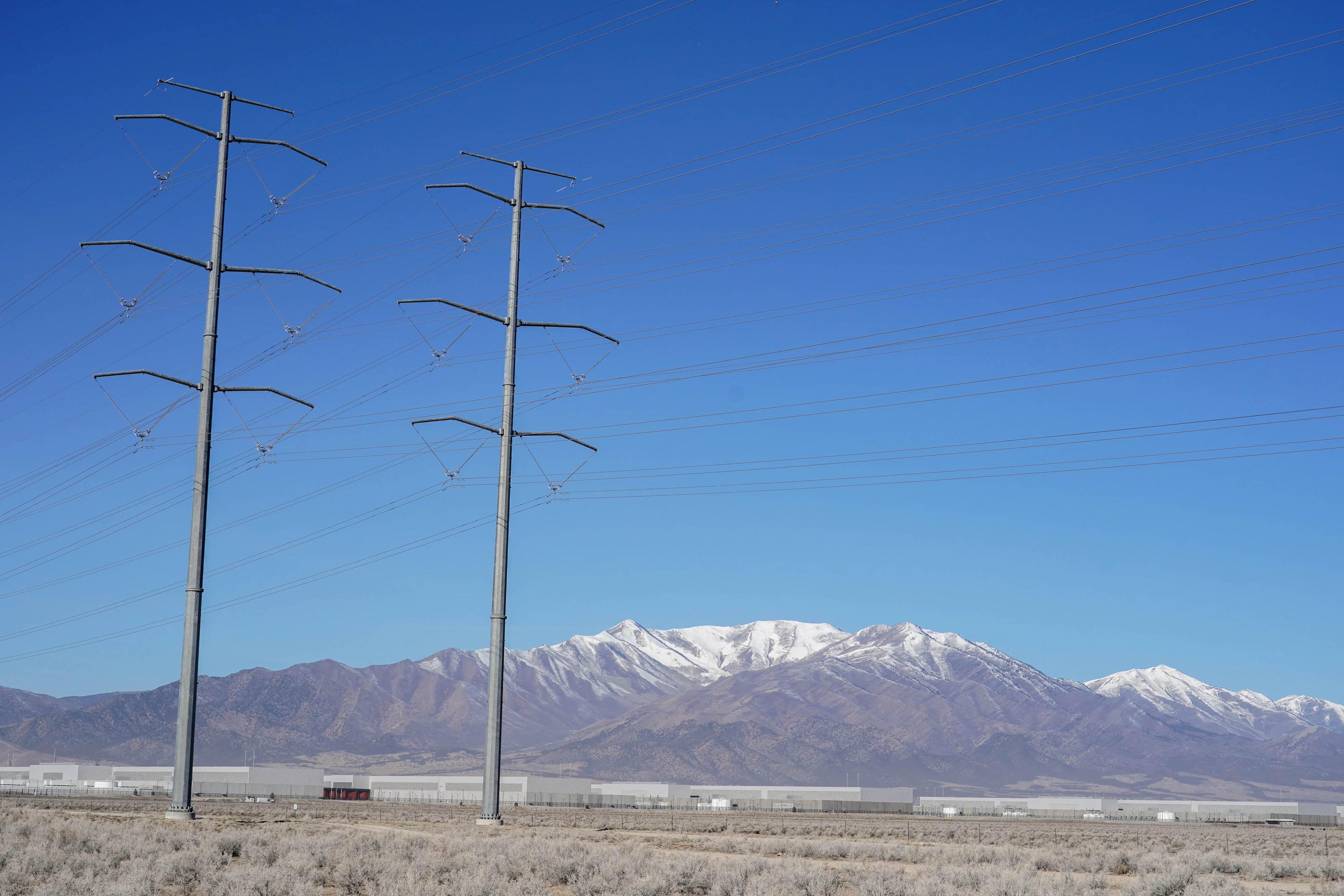
A: We are connected to the grid, but it will take time for PacifiCorp’s capacity to significantly increase. We have high voltage transmission lines coming to the property, but not at the scale needed to operate a data center. We believe in the future, the grid will make its way to us, given that we’re going to create so much demand in this area. But we are not going to wait around for it. We are going to provide the baseload and we’re going to provide the redundancy on site using battery systems, among other things. We are getting natural gas through the Kern River transmission line running from Wyoming down to southern California, which has billions of decatherms of capacity. And we will be double tapping into that transmission line – we will have two connections to that line.
Q: Do you intend to connect to the grid at all? For redundancy? Derisking?
A: We are connected to the grid, but it will take time for PacifiCorp’s capacity to significantly increase. We have high voltage transmission lines coming to the property, but not at the scale needed to operate a data center. We believe in the future, the grid will make its way to us, given that we’re going to create so much demand in this area. But we are not going to wait around for it. We are going to provide the baseload and we’re going to provide the redundancy on site using battery systems, among other things. We are getting natural gas through the Kern River transmission line running from Wyoming down to southern California, which has billions of decatherms of capacity. And we will be double tapping into that transmission line – we will have two connections to that line.
State data center scores
Q: What built up area will be on offer once your power plants are ready?
A: We are unique in that we know our power ramp is very firm. It is usually the opposite where people have buildings but getting power to those buildings is the constraint. The challenge is building the data halls. What we’ve thought about – with a handful of customers – is building temp space that allows them to safely and securely put their equipment inside. Meanwhile, we are building permanent structures. So we can start delivering pieces of buildings – we are calling them pods – of each data hall by 3Q of 2027. There will be four pods per data hall. The temp structures we can start delivering by 4Q of this year.
Q: So you will have your clients place their servers there and then they will relocate to a permanent structure?
A: This solution is for clients that want to turn on their compute in 2026. They can do that by 4Q 2026 and when the permanent halls start delivering in 3Q 2027 then they can relocate there.
Q: How many clients you have signed? Are they open to being located in temporary structures? It seems like a lot of effort and probably involves additional costs?
A: Demand is not an issue because of how quickly we can deliver. I’d say eight months ago, there was an aversion to using temp structures or even behind-the-meter power generation. We’ve seen a real seismic shift. The key question being asked is: How quickly can you get me power? That bodes well for our project because we know when we can deliver the power and we can be really creative around the structures that are going to house the equipment. We are in advanced discussions with a handful of customers.
Q: Since you are sensing robust demand, when do you think you will be signing your first customer?
A: We will start having firm agreements in the next few months. We have six buildings planned in the first phase. This could be a campus with myriad of companies that are all operating at different capacities or a group may want all six buildings and to control the entire project. Utah is, as you know, an emerging market for data centers and providing a large-scale solution in the state is attractive to many users.
The total size of the campus is 4,000 acres, and we have six buildings in our first phase.
Q: How have you been funded so far? What is the total project cost?
There is quite a bit of cost to get a site like this ready. You need to purchase the land, get it entitled, get it permitted, secure environmental and water permits – we have 10,000 acre-feet of water that is deeded to us, that’s accessed through deep underground water wells that reach an aquifer – get the transmission line designed and order the power equipment. All of these items have been capitalized. We funded the early risk piece. Data center development costs are generally in the $12 million to $16 million per megawatt range. We fit inside that range.
Q: When you selected the site, did you look at things like cyclone risk, weather risk, earthquake risk?
A: Yes. We looked at everything: seismic activity, natural disaster risk and other risks. Along with third party vendors, we have looked at historical data ourselves.
Q: Why did you choose Utah?
A: The site was selected because of availability of power, water and fiber. Low latency fiber. Those are the three core elements of the site that we really wanted. Utah provides us unique tailwinds. Governor Spencer Cox announced Operation Gigawatt [in 2024] to double the state’s power production over the next 10 years, while being power-source agnostic. Utah was also one of the first movers on state-level legislation providing a pathway for large load users to generate their own power outside of the grid (via state bill 132).
The population in Utah is unique. It’s a very young, very educated workforce. There are 16 public universities in Utah, and a large focus on bioscience and technology. Companies like Texas Instruments and Micron are located there. We really like the workforce. And then, there’s a general kind of acceptance of new power plants. Utah is a power rich state, and there’s generally not been as much backlash on new projects.
Q: How do you respond to people who say AI is a bubble?
A: It could be. I’m not going to rule that out. For our purposes we are developing something universally needed, which is power. The use case of that might change. There might be an AI inference company that needs our power, or a cloud computing company. Electrification of different industries, onshore manufacturing – everything needs a lot of power. I don’t think that we are beholden to one industry. We are providing a commodity that is universally needed.
Q: How many employees do you have right now and how will that scale?
A: We have less than 10 employees currently but we have very substantial relationships with some of the most sophisticated vendors and contractors in the data center industry. At peak, we could see a few thousand construction workers on the site, but they will not be Joule employees. Contractors we are working with include Oakland Construction, one of the largest general contractors in Utah working on the TSMC plant in Phoenix right now. AE Urbia is an architect for data centers. Spectrum is the MEP [mechanical, electrical and plumbing] consultant, with a long resume of data center projects that they’ve worked on. And we have Wheeler Machinery and Caterpillar.
Q: What is the biggest risk factor you see to this project?
A: I think there are many challenges. Challenges of getting enough skilled personnel as well as the ever evolving and changing dynamic of compute equipment. Jensen Huang [of Nvidia] talked about how there are going to be different cooling requirements for the Vera Rubin chips that were just unveiled. The requirements are ever evolving and that makes it really difficult for our potential customers to know what they’re designing.
BNEF clients can read more about data center development regional drivers and hurdles here.
Related Content