REPORT
Energy Transition Impacts: Sector and Country Impacts from a Demand-Driven Model
The global economy has reached the “messy middle” of the energy transition where renewable energy and electric vehicles are prevalent enough to affect the demand for fossil fuels without entirely displacing them. This introduces new tensions and volatilities to established industries from energy to transport and countries from Canada to Indonesia.
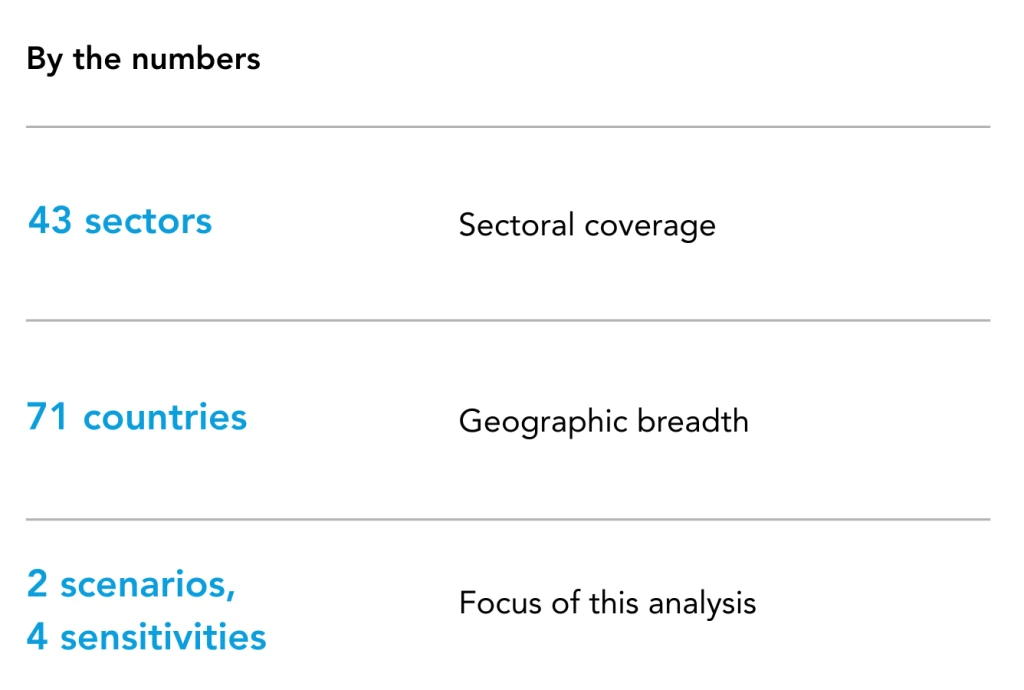
Existing macroeconomic frameworks for assessing concentrations of climate-related financial risks and opportunities typically use carbon intensity as the primary indicator of long-term exposure. Few focus on rapid technological change and product displacement of existing products over the next 10 to 15 years. What would be the impact if 80% of new cars sold in China in 2030 were electric? What would be the impact on key sectors if BNEF’s Net Zero Scenario were achieved? This analysis focuses on these questions.
- The energy transition takes place against a volatile and challenging economic environment. Governments are facing high debt levels due to the lingering effects of the Great Financial Crisis, Covid-era disruption and the stimulus measures following those events. Some countries face persistent inflation, exacerbated in some places by the energy shock triggered by Russia’s invasion of Ukraine and more recently by constraints on the Strait of Hormuz. Labor markets are in flux due to the effects of artificial intelligence, stricter immigration policies and upheaval in supply chains. The era of ultra-low-interest rates that followed the crisis in 2008 and 2009 appears to have ended.
- These economic and financial changes could lead investors to assume that the global transition toward cleaner energy will slow. However, we are observing a multi-speed transition, with some countries adopting new technologies faster and some slower, depending on their national interests. We have taken to calling this period the “messy middle.” This framework suggests potential winners and losers within that context.
- This study examines how the energy transition will impact sectors and countries most exposed to rapid technological change and the displacement of incumbent technologies. It identifies the timing, location and magnitude of sectoral change across the real economy using a non-equilibrium, demand-led approach.
- The approach contrasts with general equilibrium models, which emphasize economy-wide dynamics such as inflation, interest rates and the labor market. The approach taken here is designed to capture at the sector level areas of tension and volatility, as well as growth and contraction, under different transition pathways. To do so, we explore various sensitivities by calibrating the E3ME-FTT model from Transition Risk Exeter (Trex) and Cambridge Econometrics using scenarios from BloombergNEF’s New Energy Outlook (NEO). These approaches – E3ME-FTT and NEO – are each recognized by the central banking and financial stability community for analysis of transition impacts on specific sectors. This research marks the first time they’ve been combined.
Download report
The report will be sent to your email after completing the form.
Related Content