BloombergNEF published its latest US data center capacity forecast on Sept. 22, 2026. It’s packed full of new analysis and insights about developers, timelines, regional market dynamics and on-site power considerations. Here are our key takeaways:
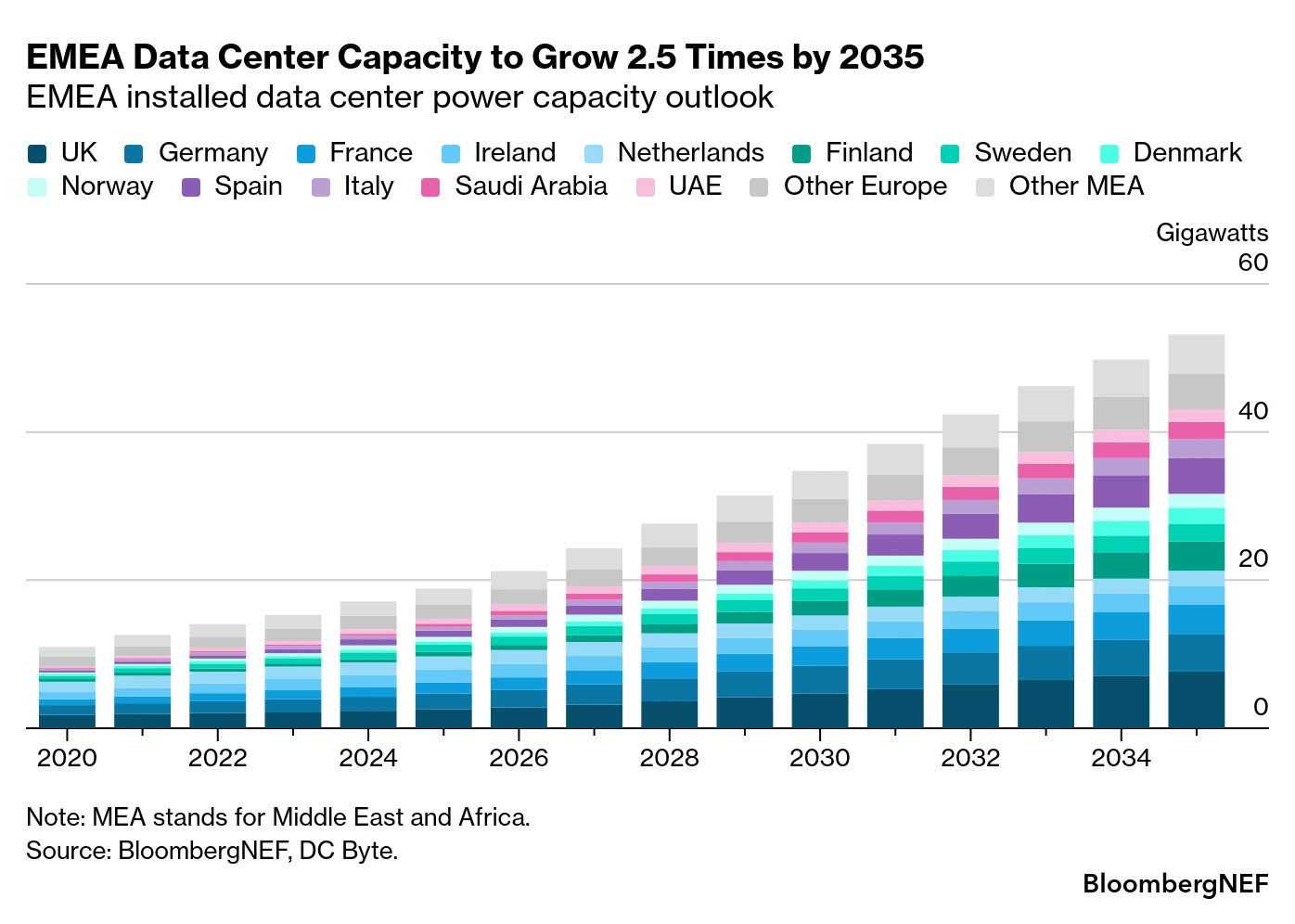
1. Installed data-center capacity grows 2.5x by 2035, in our base case
BNEF’s modelling shows 53.1 gigawatts (GW) of total data center power capacity installed by 2035, up from an estimated 19.2GW in 1Q 2026.
The UK and Germany remain the region’s largest markets, with 7.7GW and 5.1GW respectively in 2035. Spain and Finland jump up the rankings as currently early-stage projects in the region start to come online toward the end of the decade, while ongoing constraints in Ireland and the Netherlands see them both drop out of the top five largest markets.
Data centers will draw significantly less power on average than the 53.1GW peak consumption estimate, which assumes all servers reach maximum utilization on the hottest day of the year. Estimated average power draw is 28GW in 2035. That translates into 246 terawatt hours (TWh) of energy demand for the year.
2. The European Union will miss its aim to triple computing capacity, but the goal remains achievable
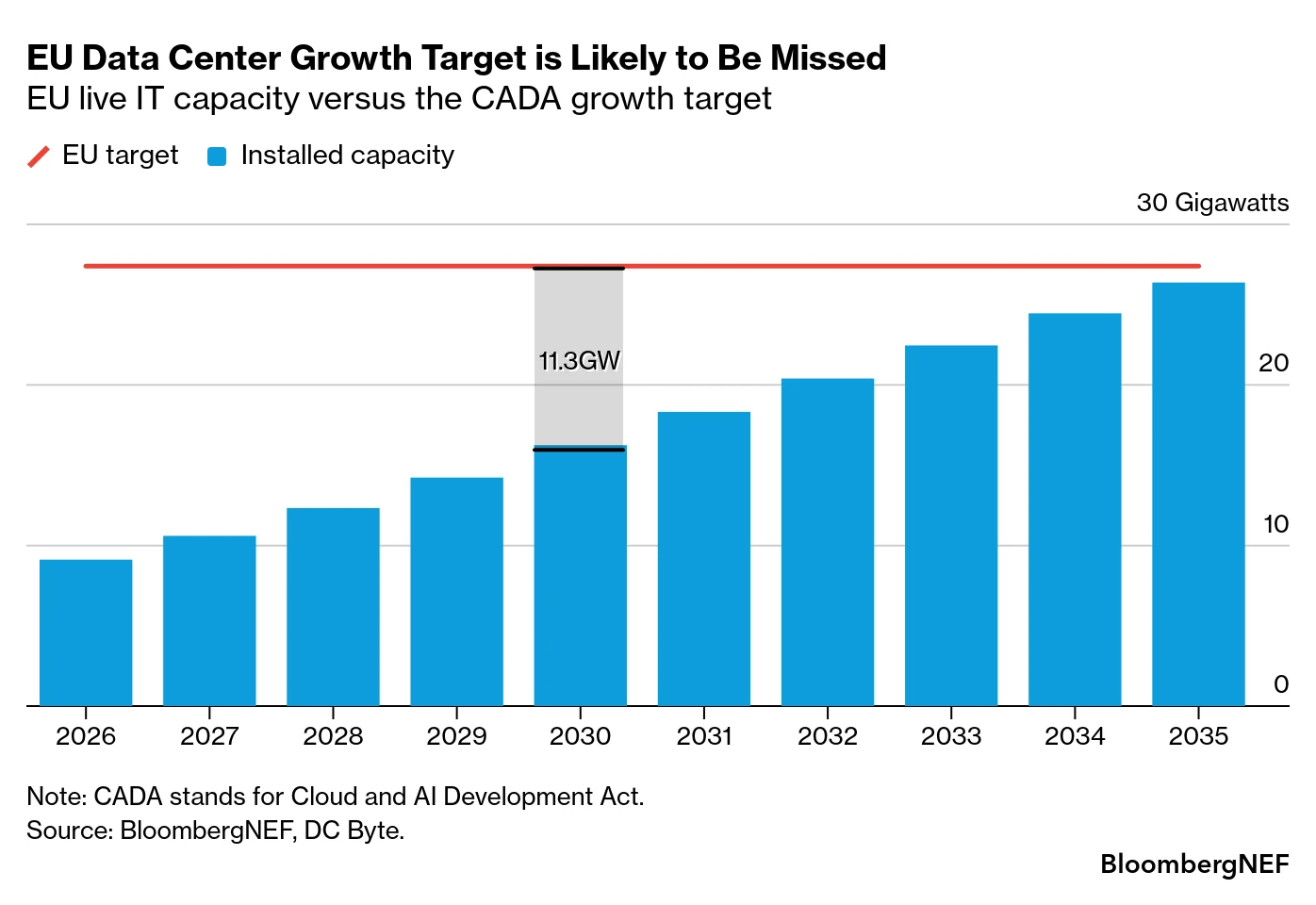
The EU’s Cloud and AI Development Act (CADA) sets aggressive 2030 data center growth targets. It’s part of the block’s wider proposed legislative framework to accelerate the development of digital infrastructure.
This target is likely to be missed, based on the current data center pipeline. BNEF’s analysis has IT capacity in the bloc growing from 9.1GW at the end of 2026 to 16.3GW in 2030. That is well short of the implied 27.4GW target.
The EU does not directly state a target capacity, instead saying it wishes to “triple” the level from 2026. Our estimate is that IT capacity will sit at 26.4GW in 2035. That’s still slightly short of the goal, but a little growth in the pipeline of projects would hit this level.
3. AI training plays a bigger role in the US than in EMEA
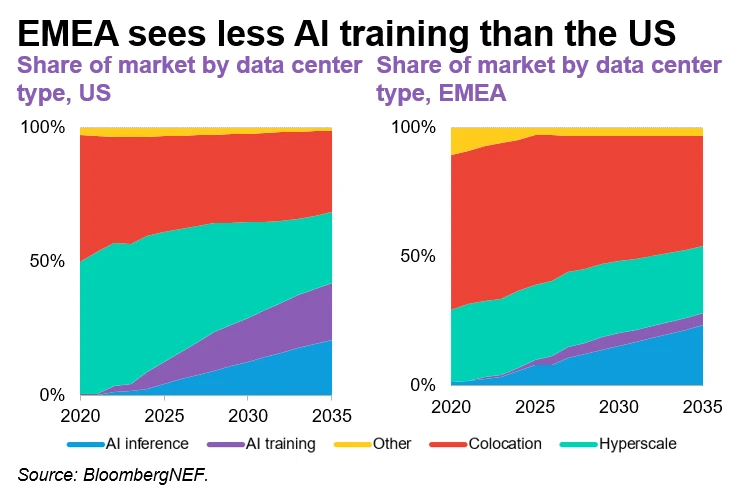
Soaring demand to train AI models is pushing up data center utilization in the US. Some 14% of US data center capacity is likely to serve AI training in 2035, according to BNEF modelling.
That figure is just 5% in Europe, the Middle East and Africa (EMEA). This is a function of demand. AI model development is dominated by the US and China, with companies typically opting to use capacity near home. European AI companies make up less than 1% of total revenue tracked by BNEF.
4. Key markets are re-writing rules to link to the power grid
Data centers are putting a big strain on power grids. Markets across Europe are responding with slimmed-down rules for those centers to get a grid connection.
Governments have competing priorities. Digital sovereignty, and a priority for data centers, increasingly is seen as strategically important. France and the UK especially have accelerated their grid connection processes. But data centers out-competing traditional industry might be politically untenable, which has led Spain and Denmark to consider rules that would help other industries tap power capacity. The rules ultimately adopted could have a big impact on which markets realize their growth prospects.
5. First-timers make up a smaller share of the European pipeline than in the US, but it’s climbing
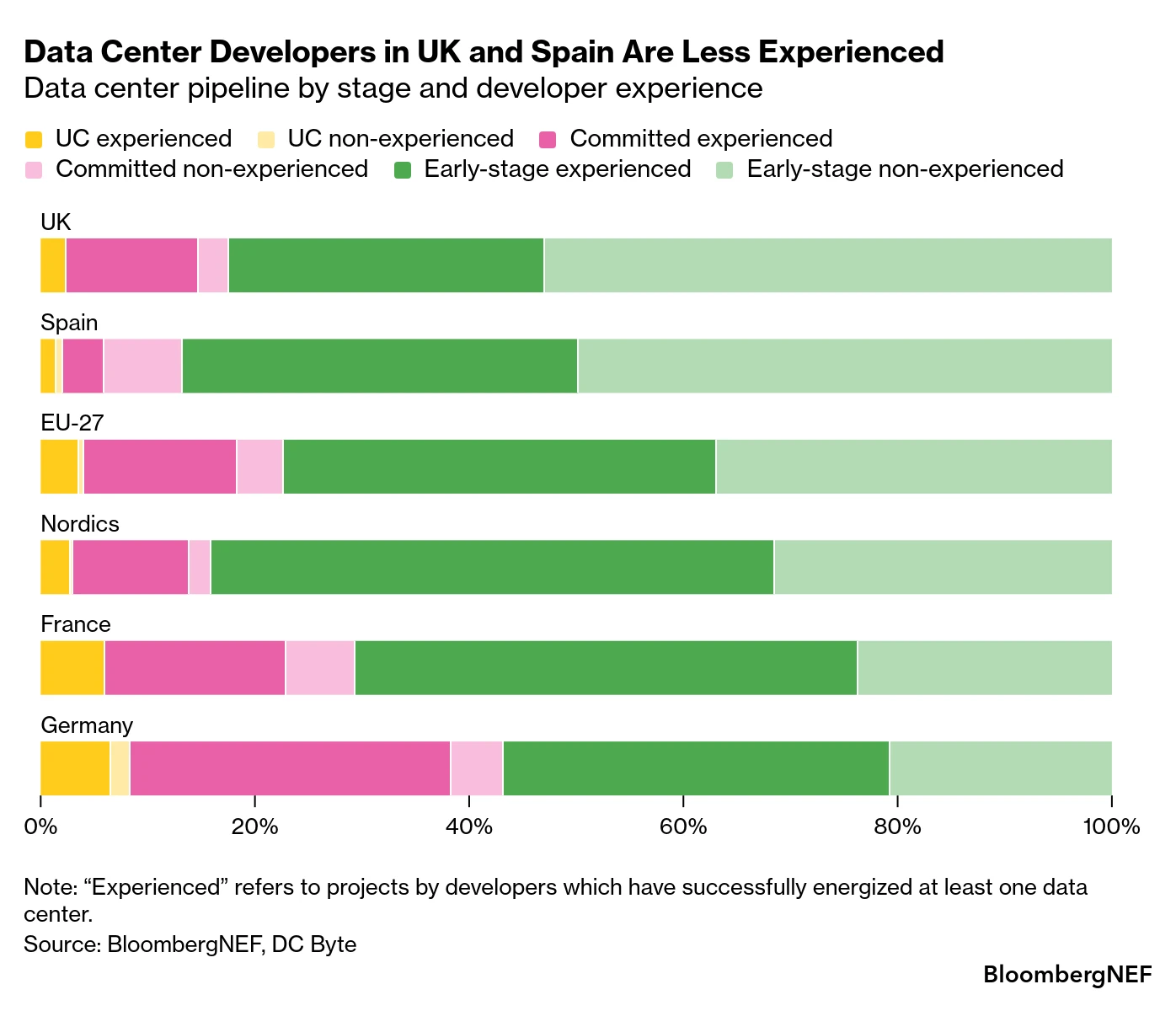
First-time developers have rushed into data center development in the US, as demand for data center infrastructure climbs rapidly. While less pronounced, a similar shift is taking place in Europe. This is something BNEF will continue to monitor, as projects by first-time developers are likely to be at greater risk of delays or cancellations.
Within Europe, this is most extreme in the UK and Spain, where first-time developers are proposing a lot of “early stage” projects – those yet to secure development permits. Execution risk on data center development is particularly acute for teams with no prior experience delivering data centers.