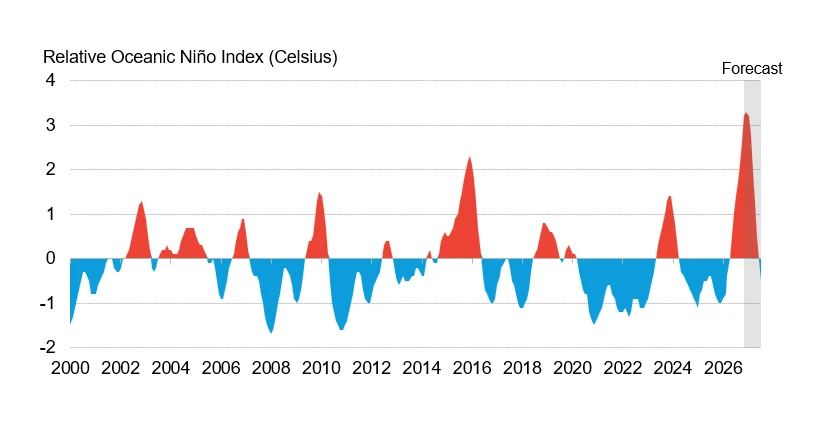
The story of the weather this Northern Hemisphere winter will be succinct: El Niño. The unprecedented strength of the developing phenomenon makes it the main meaningful predictive tool for forecasting this winter. In the US, this means milder temperatures in the north and wetter weather down south; in Europe, similarly mild conditions are likely while precipitation could favor rain, leaving the region’s snowpack, a critical buffer for hydropower, at risk. These unseasonably warm weeks should relieve price stress in gas and power markets, much-needed respite given the geopolitical turmoil. That said, near-term predictions of cold air intrusions from the Arctic lurk as an upside risk.
- El Niño’s record strength favors a broadly mild winter north of the equator, with the clearest temperature and precipitation signals across the US. Its influence on Europe is weaker and more easily modified by Atlantic and stratospheric circulation but El Niño’s global impact is expected to keep the continent 1 degree Celsius warmer than the 30-year average.
- Disruptions to an otherwise mild outlook often arrive in the form of stratospheric signals. One such event has unexpectedly started to emerge in late October. Weakening winds in the Arctic stratosphere raises the risk of sudden stratospheric warming (SSW) events, which can increase the likelihood of isolated cold air outbreaks, quickly pulling up heating demand.
- Warmth in the US should curb gas demand, with the last two strongest El Niño events in the modern era seeing gas storage sit at 19% and 13% above the five-year normal, respectively across December-February. Yet brief cold outbreaks and freeze-offs remain the principal bullish gas risk. A wetter southern storm track favors California’s hydropower, which supports around 10% of electricity generation on average.
- Europe’s mild, wet and windy outlook is bearish for power demand. Expected temperatures near 1C above normal should cut heating demand, while stronger wind supports renewable generation and rainfall boosts reservoirs and waterways. The main risk is a late cold-and-low-wind period, while rain replacing Alpine and Nordic snow may weaken hydropower in 2027.
- Approach: BNEF compiles historical climate observations since 1950 and seasonal forecasts from major modeling centers to create weather scenarios for the current winter.
Evolution of the Niño 3.4 Relative Oceanic Niño Index (RONI)
Related Content