Key Takeaways
- Record clean power plants to be added this year, and in 2027
- Tax credits and data centers driving growth in installations
(BloombergNEF) — Surging data-center electricity demand is reshaping the US power market, supporting record clean energy additions while also creating an opening for new generation from natural gas.
A large pipeline of wind and solar projects that qualify for federal tax credits underpins BloombergNEF’s forecast through 2030. Yet equipment bans, sourcing rules for tax credits and other policy barriers are making those projects more expensive and difficult to deliver.
Data center demand remains the key growth lever for clean power beyond the tax-credit-supported pipeline. Not all new electricity demand will flow to renewables, however: on-site gas power offers data centers a dispatchable and lower-cost option.
1. Data-center demand lifts US clean power outlook
BNEF expects the US to add more than 1-terawatt of solar, wind and energy storage capacity from 2026 to 2036 — over twice their cumulative capacity at the end of 2025 — even as tax credits phase out. Growing data-center electricity demand is a key driver of clean energy build. The total installed data-center capacity in the US reaches 194 gigawatts in 2035 from 47GW in 2025 under BloombergNEF’s base case.
Higher carbon prices, state-level procurement, decarbonization targets and corporate clean energy buyers support deployment, while regulatory uncertainty, and higher financing as well as equipment costs temper growth.
The stronger clean-power outlook is uneven across technologies. BNEF expects 383 gigawatts of energy storage additions from 2026 to 2036, up 34% from its May 2026 outlook, while the onshore wind forecast has risen 15%, to 100GW. In contrast, expected utility-scale solar additions have fallen 7.5%, to 430GW, as new solar-specific import tariffs weaken project economics.
Record US Clean Energy Build in 2026 and 2027
Annual US wind, solar, and storage capacity additions
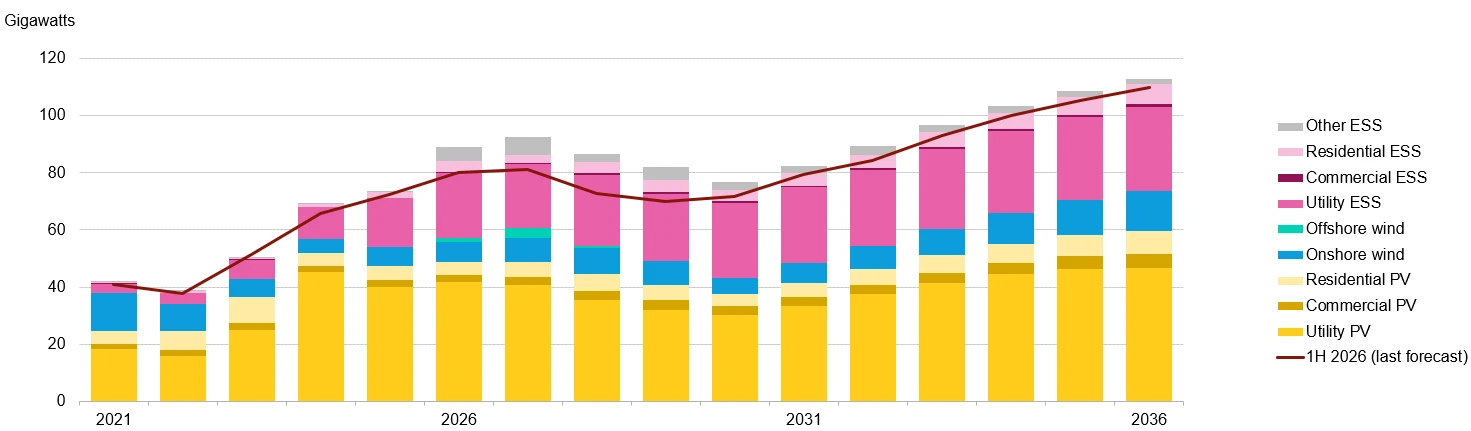
Note: BloombergNEF. Note: ESS refers to energy storage systems. Utility-scale ESS includes long-duration energy storage. PV refers to photovoltaic. Solar capacity expressed in direct current (DC) terms. Source: BloombegNEF
2. Tax-credit-eligible pipeline underpins new build, but protectionism poses risks
BNEF forecasts 89GW of solar, wind and energy storage capacity additions in 2026, and then 93GW in 2027: two consecutive years of record build. Those near-term highs are supported by a large pipeline of wind and solar projects that began construction by the July 4 deadline, allowing them to preserve eligibility for federal tax credits.
Under BNEF’s optimistic safe-harbor scenario, the US has more than 250GW of tax-credit-eligible solar and wind capacity in the pipeline. BNEF expects most of these projects to navigate uncertainty around prohibited foreign entity (PFE) rules and come online by the end of 2030. PFE rules restrict the use of equipment with ties to designated countries such as China in projects supported by tax credits.
The outlook carries financing risk as the industry awaits final PFE guidance. Banks are hesitant to fund projects exposed to yet-to-be-finalized PFE rules. Nevertheless, the stock of projects retaining legacy tax credits, or those for which PFE rules do not apply, is sufficient for deployment to continue.
Protectionist measures are also increasing pressure on project economics. Tariffs on solar equipment are raising costs, while restrictions on foreign-made inverters and other bulk-power system equipment affect solar, storage and grid infrastructure investments. Projects wielding tax credits can still absorb higher costs, but these measures add risks to the deployment outlook.
Huge Pipeline of Solar, Wind Plants With Tax Credits Secured
Estimated US renewables capacity with tax credits safe-harbored
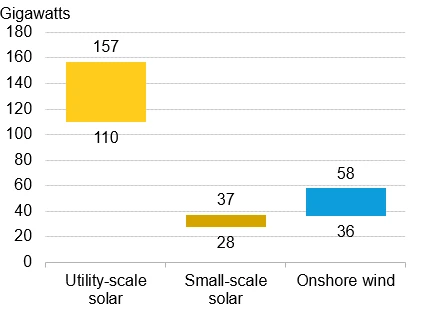
Note: GW is gigawatts. Safe-harboring refers to the process of meeting the requirements to qualify for 48E/45Y tax credits, in this case by having started construction by the July 4,2026 deadline. Safe harbor estimates based on financing announcements, permit submissions and company filings. Source: BloombergNef
3. Onsite gas power offers a competitive option for data-center load
On-site natural gas generation could meet a sizable share of rising US data-center electricity demand, potentially reducing the near-term role of renewables.
Gas currently has advantages in both speed and cost to meet the very high availability requirements of data centers. Renewables paired with storage need to be significantly oversized and therefore require higher spending to deliver ongoing reliable power, while clean firm power options such as nuclear and small modular reactors entail much longer development timelines.
BNEF tracked 165GW of announced on-site gas generation projects at US data centers, although the pipeline remains highly uncertain, with many projects missing a proposed in-service date and identified equipment suppliers.
The gas advantage is also not guaranteed. Tighter emissions rules, restrictions on new gas permitting or a higher carbon price could weaken the economics of gas-fired generation and shift more data-center electricity demand toward clean power technologies. Additionally, many on-site gas plants at data centers will need to have batteries installed to provide redundancy and boost efficiency while also protecting them from fluctuations in power demand from AI loads.
Gas Wins on Cost to Meet Data Center Reliability Requirements
Modeled all-in cost vs. time-to-power by new-build on-site technology, for a 1gW IT-capacity data center in PJM
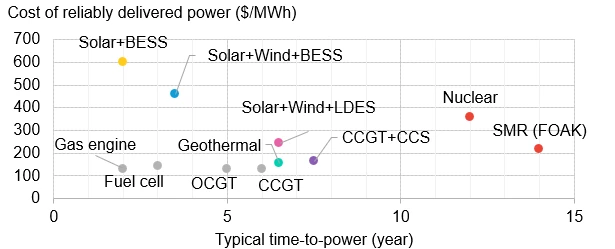
Note: Assumes a PUE, or power usage effectiveness, of 1.25 and a 95% utilization rate. Generation capacity is sized to meet hourly demand at 99.999% reliability, with all power supplied by behind-the-meter resources. RGGI carbon costs are applied to emitting technologies. CCGT=combined-cycle gas turbine; CCS= carbon capture and storage; BESS= four-hour lithium-ion battery storage: FOAK= first-of-a-kind; PV= utility-scale solar PV (DC); wind=onshore wind; geothermal=conventional geothermal energy. LDES = 100-hour compressed air long-duration energy storage Source: BloombergNEF