By Michael Liebreich
This column reflects the personal views of the author and does not necessarily reflect the opinion of BloombergNEF and its owners.
In September 2022, six months after Russia invaded Ukraine and with oil and gas prices around the world soaring, I wrote a piece entitled After Ukraine – the Great Clean Energy Acceleration, predicting that “Things are going to start moving extremely fast. The Great Energy Price Spike is going to give way to the Great Clean Energy Acceleration.”
That turned out to be one of my better predictions – over the four years since the invasion, installations of wind and solar power, sales of EVs and investment in clean energy have all more or less doubled. Even within the U.S., despite the Trump administration’s efforts, strong growth in clean energy has continued.
What the current conflict in the Gulf – in particular the closure of the Strait of Hormuz – is going to do is to provide a further push to global attempts to reduce dependence on fossil fuels. We are about to see the Great Clean Energy Acceleration 2.0 – a discontinuity in energy markets as profound as the oil shocks of the 1970s, and one that could bring forward the peak in fossil fuel use and emissions to this side of 2030.
Promises made…
Before we dive into the impact of the conflict in the Gulf, it is important to note that clean energy continues to make progress even in the U.S., despite the Administration’s attempts to stymie it.
On Inauguration Day of his second term, Donald Trump signed the Presidential Order on Unleashing American Energy, promoting the extraction and use of fossil fuels at home and abroad. He appointed as Secretary of Energy Chris Wright, founder and CEO of fracking services company Liberty Energy, who has tirelessly communicated his view that attempts to limit greenhouse gas emissions are expensive, unnecessary and failing.
The Administration has gutted the Biden Administration’s flagship legislative achievement, the Inflation Reduction Act. It has eliminated all federal support for EVs – even dismantling charging infrastructure hosted by federal agencies – and imposed tariffs on the import of renewable energy equipment. It has revoked the Obama-era Endangerment Finding that underpinned the Environmental Protection Agency’s ability to regulate emissions. It has pushed back environmental barriers standing in the way of fossil fuel development – promoting coal-based fertiliser production, fast-tracking drilling permits and bouncing world leaders into promising to import more LNG than the U.S. could conceivably export.
Internationally, the US left the Paris Agreement and the UNFCCC. The Administration has demanded that the UN, World Bank, IEA and other multilateral agencies expunge climate change from their work programs, and forced a delay to the International Maritime Organization’s ratification of an agreed deal on shipping emissions.
For a while, it looked like the strategy might succeed. The US stock market boomed, shrugging off the US tariff wars, the state of the country’s public finances, and the economic stress being felt by American households. Soaring demand for electricity for AI data centers kicked off a new dash for gas.
The clean energy sector dodged and swerved, but continued to drive for the line.
The Administration’s One Big Beautiful Bill retained the Biden-era tax breaks for geothermal power, nuclear, batteries and carbon capture and storage (CCS) – and even solar and onshore wind, as long as projects meet tough deadlines for starting construction. This, along with growing power demand, has given the US what Miguel Stilwell d’Andrade, CEO of EDP, has called “the most attractive clean energy investment environment in decades”.
In the power sector, the use of gas dropped 2.9%, despite the narrative of soaring data center demand. Coal, with the full force of the Administration behind it, had its best year since 2022. But the big winners were wind and solar, together adding 13% in output, and for the first time overtaking nuclear in the US power mix.
The US had slammed the brakes on the EV sector, but manufacturers repurposed their planned gigafactories to churn out stationary storage. According to a recent report by the US Energy Storage Coalition, cell manufacturing capacity jumped from near-zero in 2024 to 20GWh in 2025, and is set to reach 133 GWh by the end of 2027 – enough to double the total installed base of US power storage, including pumped hydro, every two years. AI hyperscalers, faced with lengthy waiting lists for large gas turbines, signed more than 20GW of renewable power purchase agreements, much of it backed up by batteries.
Even the five offshore wind projects whose construction the Administration brought to a screeching stop in 2025 resumed building in 2026, and in some cases have already begun delivering power to the grid.
In each remaining year before the next presidential election, BloombergNEF expects to see an additional 70GW of wind, solar and battery capacity built – very close to 2025’s record levels. Hardly the end of clean energy in the US.
Whistling into the wind industry
Overseas too, for a while, it looked like the US narrative might be resonating. Around the world, those in the political center began demanding a renewed policy focus on energy costs, while populists found that attacking excessive zeal for Net Zero was an effective way of mopping up votes from those feeling economic pain (even when that pain was caused by the inflation that followed Russia’s invasion of Ukraine).
Even so, total global investment in the transition grew another 5% in real terms in the year between 2024 and 2025 to $2.3 trillion, according to BloombergNEF. Global power demand grew 2.7%, according to recent figures from think tank Ember, but gas use only increased by 0.6% and coal-fired power fell by 0.6%, despite China’s addition of 90GW of new capacity. The big winners were wind and solar, whose joint output grew 18%, absorbing 99.6% of all new power demand and pushing renewables (including hydro) ahead of coal-fired power for the first time.
By the end of 2025, solar and wind together were providing no less than 20% of global electricity. Each individually now generates more than nuclear power. One car in four sold around the world is electric – one in five in Europe, one in two in China, and two in three in Nepal and Ethiopia. One heavy truck in four sold in China in 2025 was electric (and, since you ask, hydrogen truck sales collapsed back to near-zero).
Even in the world’s oil capitals, the dash for clean energy continued. Public rhetoric about phasing down fossil fuels may have been silenced, but investment in clean energy has been proceeding unchecked. Updating the country’s Energy Strategy 2050, UAE Minister of Energy and Infrastructure Suhail Al Mazrouei committed to tripling the share of renewable energy in the country to 30% by 2030, requiring investment of $60 billion. Saudi Arabia reiterated its commitment to 130GW of renewables by 2030, meeting 50% of electricity demand. Two years ago, the country had no grid-connected storage, today it hosts four of the ten largest batteries in the world, and its connection pipeline includes over 50GWh more.
The narrative of a failed transition, promoted by Dan Yergin and other fossil fuel industry voices at the start of 2025, is proving hollow. It always relied on a number of fallacies, as I explained last July in Part I of my Pragmatic Climate Reset: the confusion of energy supply with energy demand (the so-called Primary Energy Fallacy); the confusion of capital investment with economic cost; and the confusion of electricity with energy.
The narrative was also based on the false premise that any transition worthy of the name had to begin with a rapid reduction in fossil fuel use. The leading indicator of all previous technology transitions has, however, been the growth of the new, which always precedes the destruction of the old. The transition to mobile telephony wasn’t declared a failure because the global number of landlines continued to grow until 2006, 33 years after the invention of the mobile phone. Similarly, peak US horse population did not occur until 1920, over 34 years after the first internal combustion vehicle hit the roads.
As long as clean energy meets an ever-higher proportion of global energy demand (not Primary Energy), year after year, decade after decade – exactly as we are seeing – the transition is very much alive.
Dire Strait
That brings us to February 28 this year, when the US and its close ally Israel launched their attack on Iran, triggering what Fatih Birol, General Secretary of the IEA, speaking during our recent conversation on Cleaning Up, called “the mother of all energy crises”.
When it takes multiple million-dollar missiles to knock out a single $50,000 drone, but only an unmanned dinghy to punch a hole in an oil tanker, it should not be a surprise that Iran could wreak havoc on countries in the region and close the Strait of Hormuz.
The Strait has long been identified as the most significant potential choke point in global energy trade. Before the crisis, it carried about 20% of the world’s seaborne oil and a similar percentage of LNG. Over time, the destination of the oil and gas flowing through it has shifted from the US and Europe; 80% of it now heads for China, India, Japan, South Korea and other Asian destinations.
The Strait is also an artery for many of the world’s most significant commodities. An estimated 24% of seaborne ammonia passes through it, and a third each of urea and finished fertilizers. Farming powerhouses Brazil and Australia import 45% and 72% respectively of their urea from the Gulf, and India imports 80% of its ammonia, according to Illinois-based FarmDoc.
The US, with its own abundant natural gas, is not dependent on the Gulf for nitrogen-based fertilizers, but around 20% of its phosphate fertilizers pass through the Strait. Production of phosphate fertilizers requires sulphuric acid – also vital in metals refining and the manufacture of cosmetics and pharmaceuticals – and nearly half of global sulfur supply is produced as a byproduct of oil refining in the Gulf, and passes through the Strait.
Perhaps of greatest concern from a fertilizer (and hence food supply) perspective are countries like Sudan, Somalia, Tanzania, Kenya, Mozambique, Pakistan and Sri Lanka –with little ability to outbid wealthier countries for limited fertilizer supplies, and a collective population of more than half a billion people.
The Strait of Hormuz even carries around one third of the world’s supply of helium, without which no MRI scanner works, and no microchips can be made. In 2021, when the container ship Ever Given got stuck in the Suez Canal for just six days, it caused months of chaos. That could look like a blip compared to what we are about to see.
Whose move?
The energy sector is famous for using scenarios to help planning in the face of uncertainty. Right now, the funnel of uncertainty is astonishingly wide.
The news out of the region is hard to parse. The US continues to demand that Iran hand over its enriched uranium and unconditionally open the Strait, Iran maintains its right to enrich uranium and to control the waterway. At the time of writing, President Trump is claiming that a deal is all but signed, while the Iranian Fars news agency described his statement as “inconsistent with reality.”
There is a scenario in which the situation calms down, and the Strait progressively reopens. But there is also a scenario in which the Strait remains largely or fully closed, with 800 ships stuck on the wrong side. It is worth remembering that when the Suez Canal was closed in 1967 by hostilities between Israel and Egypt, 14 international ships – dubbed the Yellow Fleet – were stranded in the Great Bitter Lake for eight years.
However much the US may wish for a quick and clean end to the conflict, it is not clear why Iran would cooperate. The US appears to believe that Iran’s leaders will be driven to capitulate by the prospect of a few more weeks or months without oil revenues. The Iranians, however, will be familiar with lessons from Vietnam and Afghanistan about the US appetite for drawn-out conflicts. They will also remember the 1979 US hostage crisis: by outlasting pressure from the US for 444 days, Ayatollah Khomeini consolidated the power of the theocratic regime, secured the return of around $10 billion in frozen assets ($37 billion in today’s money), and doomed President Carter’s re-election bid.
And they have cards to play. Iran’s military is claiming to have retained 75% of its military capability, and certainly still has enough drones, missiles, fast-boats and hackers to resume asymmetric warfare if attacked again. The Revolutionary Guard, having plundered the country for decades, has plenty of wealth salted away. The country has powerful friends in Russia and China, only too happy to see a growing rift between the US and its historic allies. And the country has a growing ability to transit goods to and from Asian markets overland, particularly via Iraq, Pakistan and the Caspian Sea.
The US, by contrast, sees its position weaken with every week that passes. The November US mid-terms get closer; Trumps poll ratings decline; the MAGA coalition fractures; legal pressure to get approval for the war from Congress increases; and the pain felt by US allies in the region increases.
Given this dynamic, I would not be surprised to see the Iranians playing cat and mouse for many months. They could even try to outlast Trump altogether.
The markets have spoken – not really
So far, the markets have remained inexplicably calm.
In the week before news of the US-Israeli attack broke, the oil price (I’ll be using WTI figures throughout) hovered around $67 per barrel, and it took an inexplicable five days for prices to drift up 20% to $80. By March 9, the market was a bit more spooked, and the price briefly touched $120.
At that point the International Energy Agency released 400 million barrels from its strategic reserve – one third of its holdings and over twice the largest ever previous release – which calmed the market until the start of April, when prices again approached $120.
The announcement of a ceasefire then brought prices back down to the mid $90s. They have bounced around the $100 mark ever since, despite several rounds of failed peace talks, wild gyrations in US statements on the situation, the imposition of a US blockade on the Strait, and continuing contradictory news about the negotiations.
Meanwhile, a huge effort has been under way to get Gulf oil and oil products to market by alternative routes, as well as to find alternative sources of supply. The UAE is exporting around 1.6 million barrels per day through its Habshan–Fujairah ADCOP pipeline and Saudi Arabia has been routing seven million barrels of oil per day to the Yanbu terminal on the Red Sea. Non-Gulf producers are ramping up their output – opening valves to the max, red-lining rates of extraction and delaying maintenance.
In any scenario involving an extended closure of the Strait, the world will lose up to ten million barrels per day of oil, equivalent to around 10% of global demand, and perhaps double that proportion of oil products. If that happens, it’s hard to see the oil price remaining below $200/barrel, and the impact on the global economy being anything but catastrophic.
It is worth recalling that during the 2014 China-driven commodity super-cycle, the peak price of $147/barrel would translate into $225/barrel in 2026 money.
For the current approximately $100/barrel oil price to make sense, traders must think there is a very high chance of the Strait completely reopening in coming weeks. I wish I shared their optimism.
Natural gas is not oil
At this point, let’s talk about the likely difference between the trajectory of oil and gas in the event of a prolonged closure. The Strait moves 20% of global oil and 20% of LNG, so the impact of closure on both should be about the same, right? Wrong.
In the case of oil, closing the Strait wipes out 20% of total global supply. In the case of gas, closing the Strait only wipes out 20% of global seaborne supply, which is just 3% of total global supply. In addition, however, there is a difference in how quickly the world could reduce demand by turning to alternatives – EVs in the case of oil, and renewable power in the case of natural gas.
As we have seen, EVs now account for one new vehicle sold in every four. But since the global vehicle fleet only turns over once every 18 years or so, for now there are still only 58 million EVs on the road, or just under 4% of the total fleet. And since land transportation accounts for just under half of oil, so far EVs have only suppressed demand for a bit over 2 million barrels of oil per day, out of total demand of over 100 million barrels.
Let’s do a thought experiment: what would happen if EV sales suddenly doubled to 50% of all vehicles sold worldwide, and stayed there? It would take nearly a decade for demand to drop by an amount equivalent to the oil that would usually flow through the Strait of Hormuz.
Now let’s do the same thought experiment for gas. Natural gas in power generation can be substituted extremely quickly by – regular readers will already have guessed the answer – wind and solar. What happens if you double their rate of installation? Between 2024 and 2025 power generated from wind and solar grew by 840 TWh globally. However, the 110 billion cubic metres (bcm) of LNG that passed through the Strait of Hormuz in 2025 would have been enough to produce only 600 TWh of electricity. Not only are wind and solar already absorbing all growth in power demand, if you doubled their rate of installation (for which the manufacturing capacity already exists) it would take just 9 months to compensate for the loss of LNG passing through the Strait of Hormuz as well.
Before you take to social media to point out that only around a third of LNG is used in power generation, or that wind and solar cannot fully replace gas, none of that matters. For supply and demand to balance, all you need is for 110 bcm of gas demand to be eliminated, anywhere in the world. The wonders of the market will do the rest.
What this means is that in the event of a prolonged disruption in shipping via the Strait of Hormuz, the oil market would be in for many years of high prices, while gas – and hence power markets – could return to normal much more quickly.
Great Clean Energy Acceleration 2.0
What can we learn from events after the Russian invasion of Ukraine?
Between 2021 and 2025, according to BloombergNEF, global annual installations of wind and solar increased 170% to 815GW from 300GW; their joint output went from meeting around 12% of power demand to 20%. Wind turbine manufacturing capacity grew 76% to 155GW per year from 88GW, while solar wafer capacity soared 350% to about 2TW from 450GW. Annual sales of EVs increased by 220%, reaching 20.8 million – jumping from fewer than one in ten light vehicle sales to around one in four. In China, heavy EVs shot up from around 1% of truck sales in 2021 to just under 25% in 2025. Annual investment in the energy transition doubled from $1.2 trillion to $2.3 trillion globally.
I called it the Great Clean Energy Acceleration – but it will prove to be just a foretaste of what we are about to see. Shortly after the emergency release of 400 million barrels of oil by the IEA, its head Fatih Birol came on Cleaning Up and explained how he expected the current crisis to give a big boost to the uptake of renewables, EVs and nuclear power, as well as placing a renewed focus on energy efficiency.
During the Great Clean Energy Acceleration 1.0, Asia was insulated from the worst economic impact of the Russia-Ukraine war. Indeed, China and India were able to buy sanctioned oil, gas and related commodities at discounted prices. This time, Asia is directly affected, being the destination for over 80% of the oil and gas that normally passes through the Strait of Hormuz. Can we imagine any world in which India, China and Asian nations do not dramatically accelerate their efforts to reduce that painful vulnerability?
Things could move very fast indeed. In 2022, in the aftermath of Russia’s invasion of Ukraine, the Baltic states all stopped importing Russian gas and LNG within two months. Pakistan was also very quick to act. Back in 2022, gas accounted for around 30% of the country’s power generation and its economy was badly affected by the energy price spike. Asia-bound LNG cargoes were suddenly diverted to Europe.
Over the next three years, Pakistan imported 46GW of solar panels, mostly from China. Its farmers alone installed 20GW of solar irrigation. Today, solar power accounts for 25% of Pakistan’s generation. Together with investment in domestic gas production, this has pushed imported gas below 10% of its power mix and enabled the country to cancel 21 LNG cargoes that had been scheduled for delivery in 2026 and 2027.
According to Renewables First and the Centre for Research on Energy and Clean Air, Pakistan’s solar surge has helped it avoid around $12 billion in oil and gas imports since 2021, and will save the country an additional $6.3 billion by the end of this year.
False friends
Clean energy will not be the only beneficiary of the crisis. As Birol also pointed out, we should also expect a surge of investment in oil and gas and a resurgence in coal use.
The oil shocks of the 1970s led to massive investment in diversifying production away from OPEC countries. Investors today are too wary to unleash anything on a similar scale, but high oil and gas prices will certainly drive more exploration. We will see importers preferentially “friend-shoring”: buying from countries they see as more reliable. Oil and gas from Norway and Canada will trade at a premium.
We are also seeing debates about restarting domestic exploration in countries that had dialled it back in the name of climate action, such as the Netherlands, Denmark, Germany, Mexico and New Zealand. In the UK, the Conservatives and Reform (the nativist party that made major gains in the recent local elections) have both made restarting North Sea exploration the central plank of their energy policies, even though official figures for reserves and contingent resources amount to just 9.2 billion barrels of oil-equivalent, compared to 47.7 billion already extracted – enough to meet European demand for less than a year.
In countries without meaningful oil and gas reserves, we will see the use of coal pick up, at least for a few years. However, we will also see the acceleration of a trend that was already evident before the conflict: investment to make plants more flexible. Major equipment manufacturers like Siemens, Mitsubishi and Doosan all offer retrofits to enable plants to operate at lower minimum power and ramp output more quickly – aimed at saving fuel costs and making coal work better in renewable-heavy grids.
In the Pragmatic Climate Reset Part II, I explained how retaining or even building gas peaking plants can enable a lot more wind and solar to be integrated into power systems; in Asian countries without domestic natural gas resources, that role will increasingly be played by coal.
Counting the cost of fossil fuel price volatility
As the implications of the current crisis sink in, we should expect the short-term scramble to replace oil, gas and other commodities stuck on the wrong side of the Strait of Hormuz to give way to a profound re-evaluation of the wisdom of exposure to volatile fossil fuel prices.
Defenders of the fossil-based status quo are always keen to point out that wind and solar power are not as cheap as their supporters claim, because of externality costs that they impose on the power system. It’s a fair point. Once the penetration of variable renewables reaches a certain threshold, for every dollar invested on the supply side a matching dollar must be invested in integration – new transmission lines, digital controls, batteries, stability assets, and so on.
However, in pointing out these externality costs of variable renewables, defenders of fossil fuels are missing the much bigger externality costs imposed on our economies by fossil fuels. They are used to downplaying the long-term costs of climate and pollution; the war in the Gulf is going to make it impossible to obscure the immediate externality costs of commodity price volatility.
You think of this as the second oil spike in four years? Go back as far as the first oil shocks in the 1970s, and you’ll see that it is in fact the 14th oil shock of the past 60 years. Eight times in six decades the oil price has soared by more than 30% over the course of a year, and six times it has crashed (an oil price crash is as devastating to producers as a price spike is to consumers).
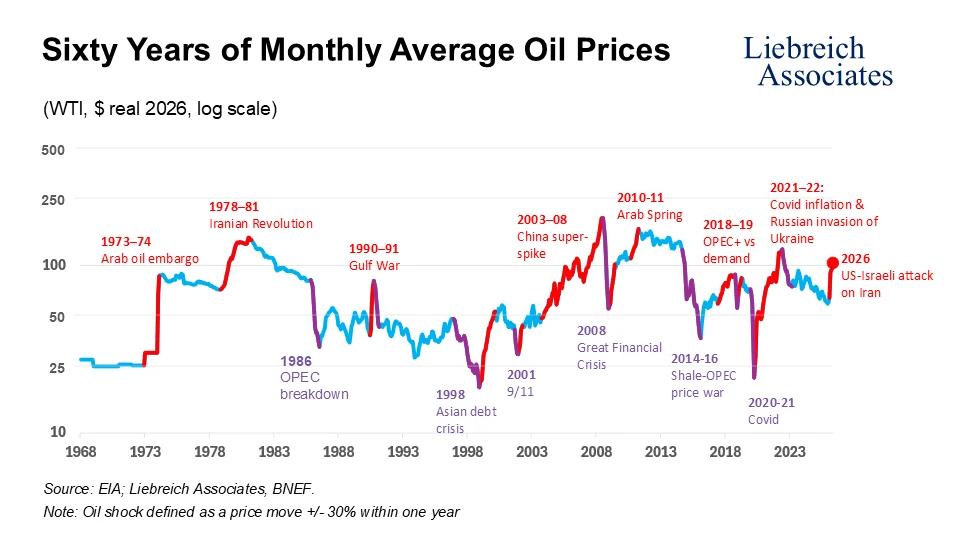
The world does not enjoy long periods of serene, fossil-fuelled growth, followed by the odd month of price turmoil. The reality is that it experiences an oil price shock every four years, ushering in a period of economic stress that lasts on average more than a year. The UK’s Climate Change Committee has calculated that the cost to the UK of just one more fossil fuel shock would be more than the entire cost of achieving net zero by 2050.
Countries are already starting to get to grips with this reality. We see it in the determination of NATO allies to stay out of the Iran war. We see it in the visits by world leaders to China. We see it in Mark Carney’s speeches in Canada. We see it in the energy decisions already being made around the world.
China’s state-owned oil and gas company Sinopec has already cancelled a planned expansion of an LNG import terminal. Vietnam’s Vingroup has cancelled 4.8GW of LNG-fuelled power generation. The EU is bringing forward its Accelerate EU package, designed to “address EU’s rising energy costs on volatile fossil fuel markets.” Pakistan has decided to go to 95% domestic clean electricity by 2040.
Remember how European car companies had to dial back their EV ambitions because Europeans allegedly didn’t want them? In the immediate wake of the outbreak of the war in the Gulf, sales of EVs in Europe jumped from 25% of new cars to 50%. Populations may be sick of being lectured on climate change, but they are acutely aware of soaring prices at the pump.
Where the first Great Clean Energy Acceleration took renewables to the point where they were absorbing all growth in electricity demand globally, the Great Clean Energy Acceleration 2.0 is set to take renewable energy (with a tiny bit of help from nuclear power) to the point where it absorbs all growth in energy demand.
We should now see peak fossil fuels and emissions this side of 2030.
The Accidental Climate President?
By attacking Iran, the US unwittingly unleashed another round of acceleration in the world’s long-term shift to clean energy. Indeed, this may well have set in motion a chain of events that pushes the fossil fuel industry into retreat in the next few years, after nearly three centuries of consistent growth that has defined the modern era and triggered the Anthropocene.
–Michael Liebreich is Chairman and CEO of Liebreich Associates and Managing Partner at EcoPragma Capital LLP.