Key Takeaways
- Energy storage additions headed for a record in 2026 and 2027
- Local battery supply chains grow as activity shifts from China
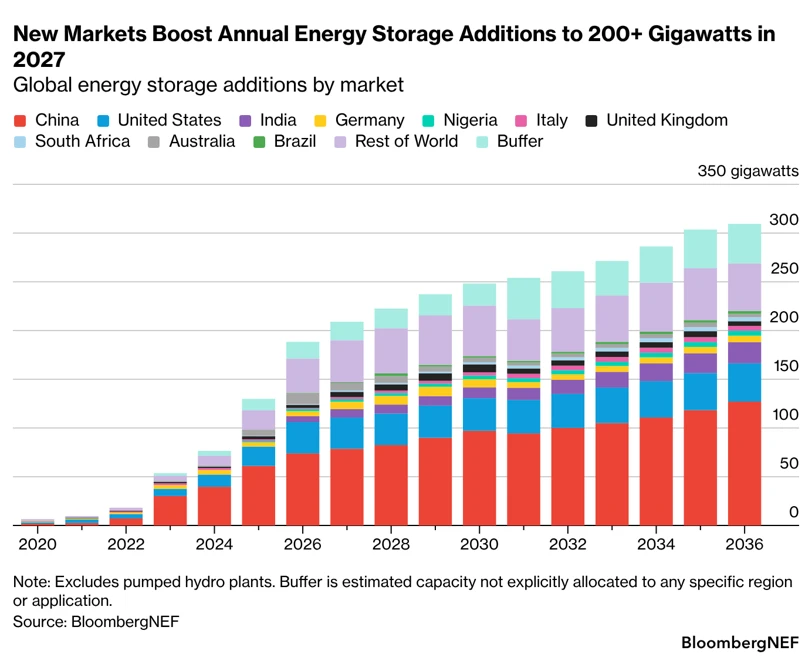
The global energy storage market – led by China and US – is seeing new growth centers emerge. This year, India will add 26 times more batteries than last year and Australia will almost double its annual addition, contributing to the global 45% year-on-year growth in gigawatts in 2026 being projected by BloombergNEF in its latest forecast.
The record will be followed by yet another one in 2027 – when energy storage additions top 200 gigawatts – as several more markets scale deployment. Drivers of growth include rising solar penetration, storage-pairing mandates and fiscal incentive programs. Meanwhile, protectionist policies are reshaping regional battery-storage supply chains – promoting local component production and restricting Chinese imports. Chinese equipment suppliers are increasingly drawn to new markets with fewer restrictions as a result.
Cumulative storage capacity grows 10-fold to 3 terawatts or 11 terawatt-hours in 2036 from 2025 levels.
High of 2026
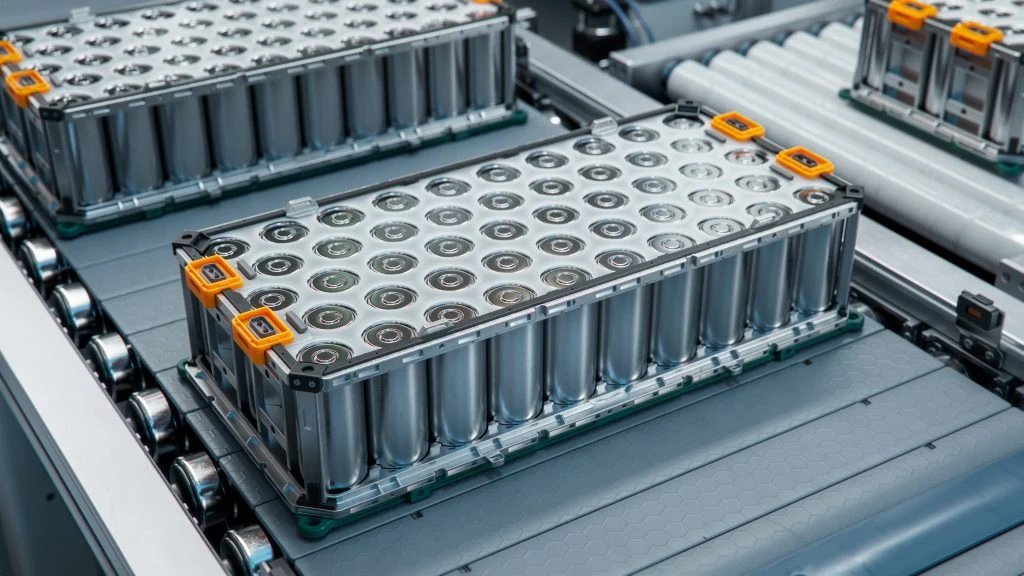
Energy storage deployment is set for another record in 2026 by adding 188 gigawatts (GW) or 535 gigawatt-hours (GWh) of energy storage projects, 62% of which are installed in China, the US and Australia, according to BloombergNEF’s latest outlook.
China is surprisingly strong given the phaseout of a major policy last year which mandated energy storage for renewables build. The transition to different revenue and business models led to uncertainty in the market this year, but new supportive policies are reinforcing the country’s lead. These include a firming requirement for standalone solar and wind projects and a renewed 300GW deployment target by 2030.
The US maintains strong build, supported by preserved tax credits and accelerated by on-site energy storage demand from data centers. Meanwhile, India leapfrogs peer markets as tender-driven annual additions top6GW this year from a few hundred megawatts last year. Beyond the UK, Germany and Italy, which led European build last year, a myriad of countries emerge in the gigawatt-scale addition this year, including Bulgaria, Romania, Poland, France, Greece, Netherlands and Ukraine.
Global annual additions grow 11% year-on-year in gigawatts in 2027 to 209GW/638GWh, as deployment broadens beyond today’s largest markets. Spain, the United Arab Emirates, Chile and Japan accelerate build, supported by power market fundamentals, diversified revenue stacks and utility-led procurement activity. By2036, the growth engine shifts to emerging regions such as Latin America, Sub-Saharan Africa, Southeast Asia and other European countries.
Sodium-ion batteries are increasingly gaining traction amid the recent increase in material prices for lithium iron phosphate materials. Sodium-ion battery storage has a lower fire risk and can operate across a wide temperature range, reducing the need for liquid cooling and auxiliary energy use. Despite these advantages, limited manufacturing scale and cost competitiveness pose hurdles to adoption for sodium-ion batteries as well as other non-lithium long-duration energy storage. Lithium iron phosphate (LFP) is expected to be the primary chemistry for energy storage over the next decade due to its cost competitiveness, high cycle life and supply chain dominance.
Battery-storage supply chains reset
Several markets are scrutinizing supply chains much more closely and mandating more localization, complicating market entry for Chinese equipment suppliers. The US leads these efforts with tariffs and incentives for domestic battery storage production and use in projects, while restricting the use of equipment reliant on supply chains involving China. Similar concerns on cybersecurity and supply-chain security are guiding policies across the European Union and Japan.
With these barriers, Chinese equipment providers are tapping into markets with fewer restrictions, such as the Middle East, Latin America and Sub-Saharan Africa. Protectionist policies are also in place in other countries, such as South Korea, India and Brazil, although their measures are not as stringent as the ones in the US.
Pairing with renewables
Globally, energy storage installations co-located with renewables, particularly solar projects, are gaining more traction. By the end of 2025, as much as 69GW/196GWh of energy storage projects had been paired with299GW of solar. Growing volume of solar electricity curtailment and price cannibalization in key markets such as the US, Australia and Chile continue to drive additions.
Despite an expiring policy mandate for co-location of batteries with renewable energy projects in China, nine other countries including India, Mexico, and the Philippines, have also implemented regulatory or auction-linked mandates. Deployment of renewable-plus-storage projects is seen remaining robust over the next few years.
Related Content