Key Takeaways
- Chipmaker has disclosed up to $118 billion in guarantees
- Leases and equity investments add a further $110 billion
By BloombergNEF
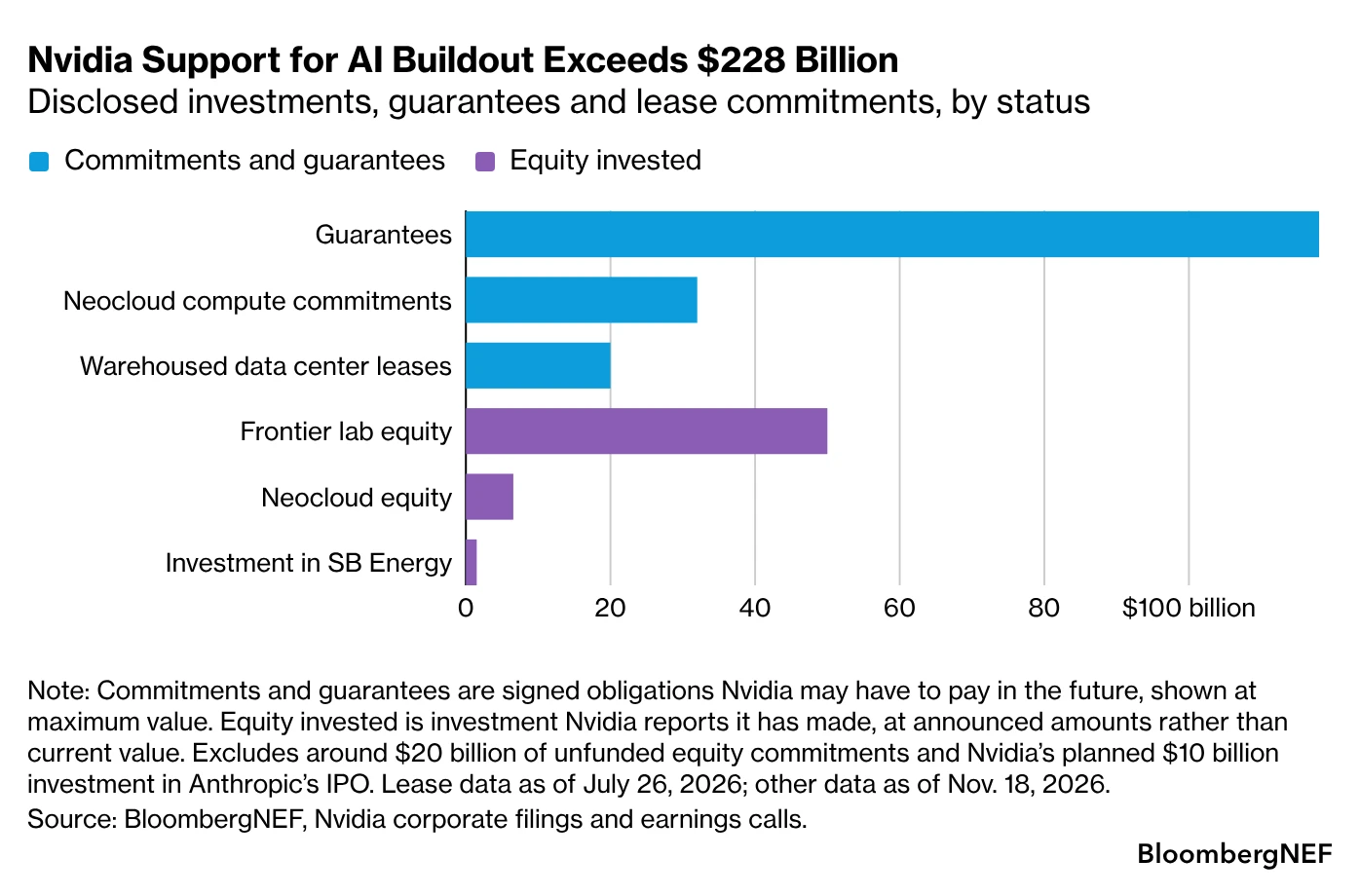
(BloombergNEF) — Jensen Huang has left Nvidia with a data center financing ecosystem worth over $228billion, including more than twice the credit support of any other major data center backer.
With Huang’s ouster, the future of this financing strategy – what the industry calls “balance-sheet-as-a-service”– will hinge on his replacement’s direction. A pivot by the chip giant could slow financing for neoclouds and other data center firms highly reliant on its support.
During its 3Q earnings call Tuesday, Nvidia said existing customer commitments and operations wouldcontinue without interruption, but did not respond to BloombergNEF’s earlier request for comment on future financial support. Interim Chief Executive Officer Colette Kress noted during the call that Nvidia would betaking a “very strong look” at the types of fi rms it supports going forward, saying that “a lot of things have changed” over the last quarter.
The chipmaker has used multiple financing mechanisms such as lease agreements, guarantees and equity investments to back neoclouds and AI labs. A pullback from these approaches would leave some data center developers with higher financing costs, fewer viable projects or a greater need for support from hyperscalers and private capital. Companies developing data centers have raised
at least $1.8 trillion between 2020 and 1H2026, according to recent BNEF analysis.
Nvidia dominates credit support
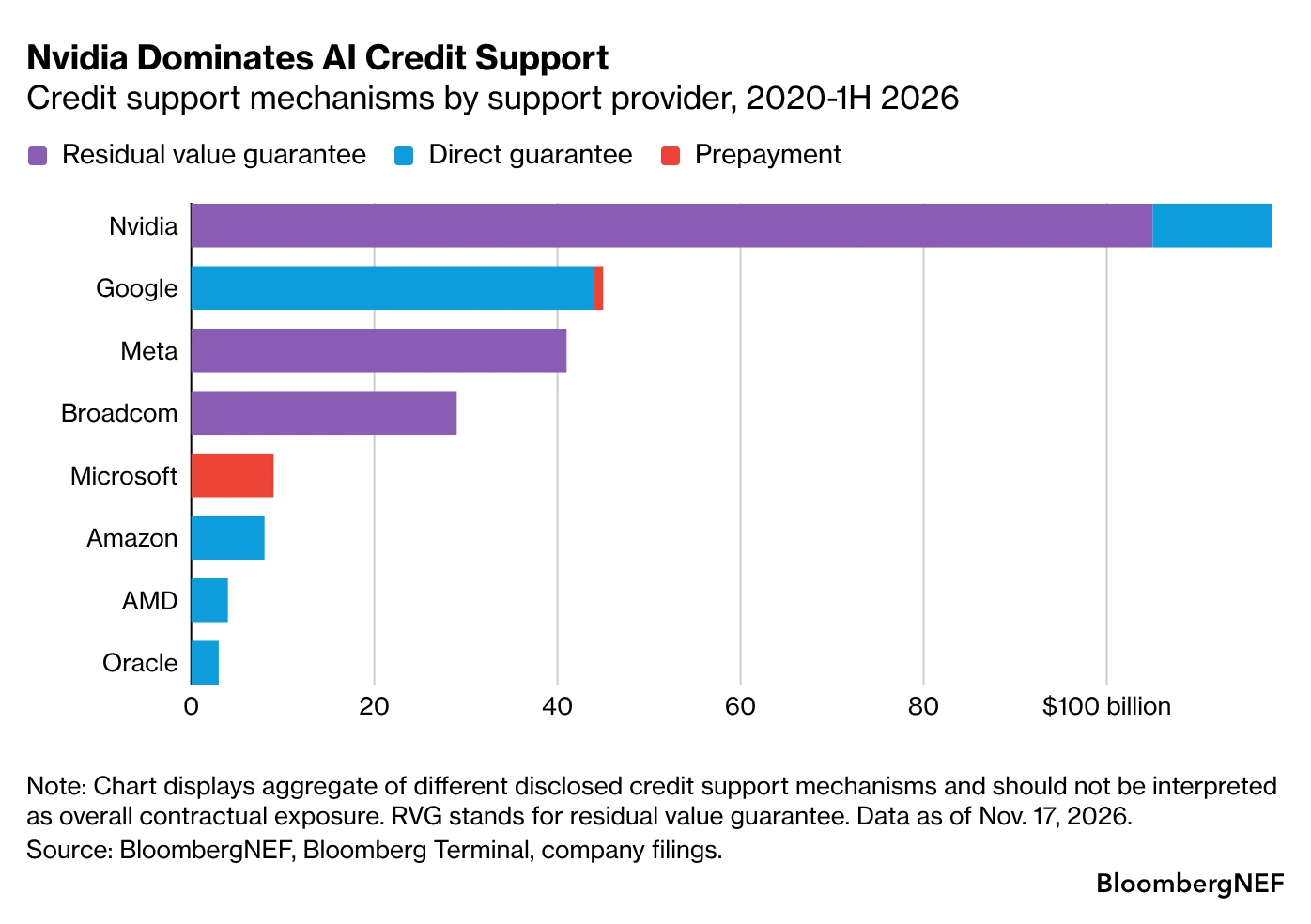
Nvidia has committed up to $118 billion to backstop its customers, a key condition for less credit worthy data center developers to unlock financing. The total is far larger than other players following the same strategy, such as Meta and Google, according to BNEF data.
Chief among Nvidia’s deals is a $105 billion residual value guarantee for the initial 4.25 gigawatts of OpenAI’s planned campus with SB Energy in Ohio. The guarantee covers any shortfall between a minimum lease value and proceeds from a replacement lease or sale if OpenAI becomes insolvent or stops paying. SB Energy, a subsidiary of SoftBank, agreed to enter the lease, power-purchase and transmission agreements only if Nvidia provided the backstop.
While valuable, Nvidia’s guarantees have limits. In the company’s latest earnings call, Kress clarified that its OpenAI guarantee is for the operational data center, not construction or development, and would cease to apply in the event of delays.
Nvidia’s backing extends beyond guarantees
Nvidia established a $500 billion financing platform for AI infrastructure with BlackRock, Goldman Sachs, Blackstone, KKR, Apollo and Brookfield, agreeing to provide support of up to 25% for selected deals, creating a maximum exposure of $125 billion. That support, called a residual value guarantee, provides a recovery floor for lenders by covering the shortfall between outstanding debt and the liquidated asset value in the event of developer insolvency or default.
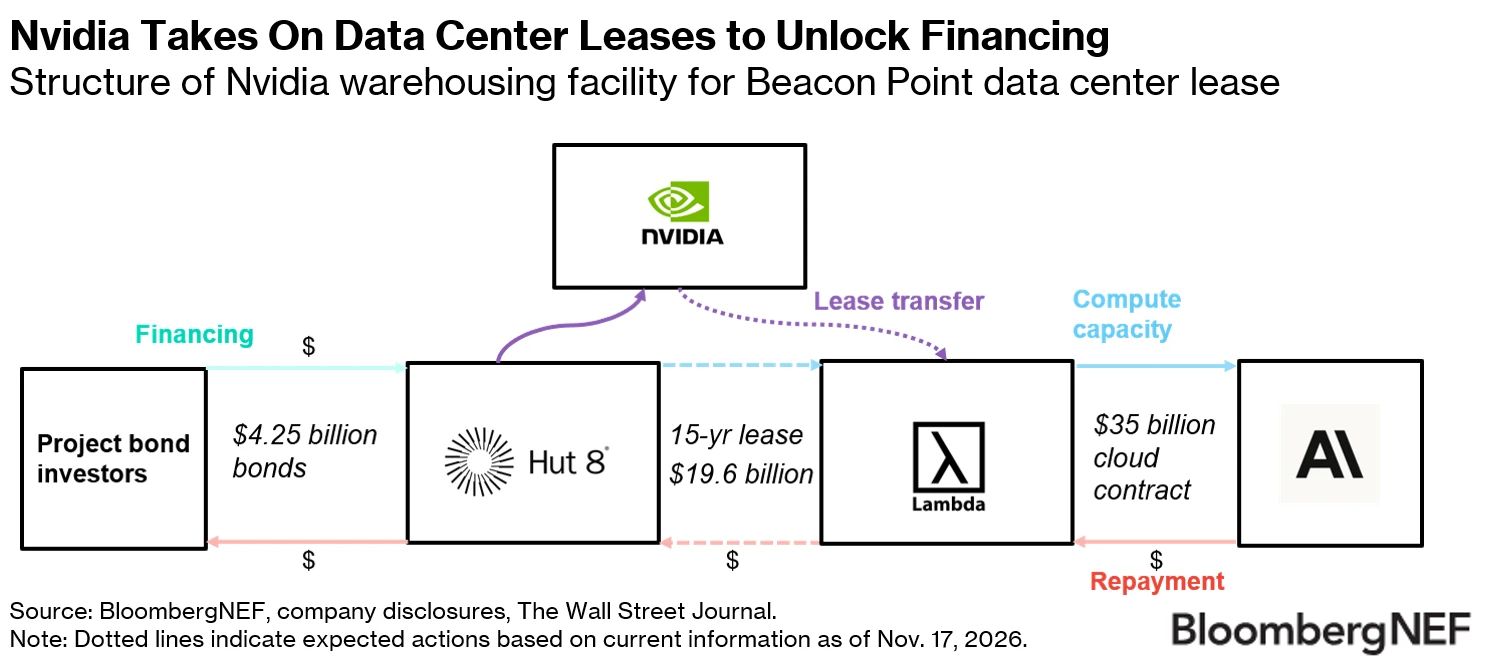
Nvidia has committed to $20 billion of data center leases as a bridge for its customers, storing capacity on its balance sheet before transferring it later. One example is Hut 8’s Beacon Point campus in Texas. Nvidia is the lease holder, while neo cloud Lambda will use the facility to serve an approximately $35 billion Anthropic cloud contract, according to The Wall Street Journal. Hut 8 utilized Nvidia’s off take agreement to raise $4.25 billion.
Nvidia also serves as a flexible off taker for several of its neocloud customers, signing up to $32 billion in AI compute commitments. These favorable agreements give neoclouds a revenue floor on part of their capacity, helping them raise debt, while allowing them to resell that capacity to higher-paying third parties. Nvidia earns revenue on the upfront hardware sale and may receive a share of neocloud revenue above the floor.
In its 3Q CFO commentary, Nvidia said the commitments take effect only if the neo clouds secure financing and Nvidia accepts the deployed capacity, conditions not described in prior disclosures. Lenders can still finance a project against a commitment that activates only when the loan closes, but Nvidia has no obligation to support unfunded projects. Its latest total of $32 billion in compute commitments is down from $36 billion the previous quarter.
Nscale has the highest Nvidia exposure
In addition to its contractual support, the chipmaker has also taken equity stakes in several of its clients, investing at least $58 billion in AI labs and neoclouds.
Reliance on Nvidia is strongest in earlier-stage neoclouds such as Nscale. Nvidia has committed almost half of Nscale’s $6.7 billion in equity raised, with a further $1 billion in convertible loan notes still yet to close. The chipmaker has guaranteed up to $860 million of Nscale’s rent at a major site in Texas, which helped the neocloud raise up to $1.85 billion in GPU-backed project finance to purchase Nvidia’s chips.
The UK-based neocloud has yet to prove its ability to execute and grow. Nscale currently has only 106megawatts of operational IT capacity, against nearly 1.3 gigawatts of contracted pipeline. The company said ithas a “line of sight to approximately 10 gigawatts of potential power capacity” in its IPO filing, under scoring the steep operational ramp ahead to deliver on its computing contracts. Nscale’s existing sites have faced delays, according to reporting by Bloomberg News.

More established neoclouds have less direct financial reliance on Nvidia, but most still depend entirely on its hardware. Huang’s support for neoclouds was part of a strategy to stimulate additional demand for Nvidia’s chips. Several of Nvidia’s core customers – including the hyper scalers, OpenAI and Anthropic – are all creating or already selling their own AI hardware. A slower financing push would not immediately affect Nvidia’s product lead but could reduce the demand from emerging customers in the long run.
Related Content